

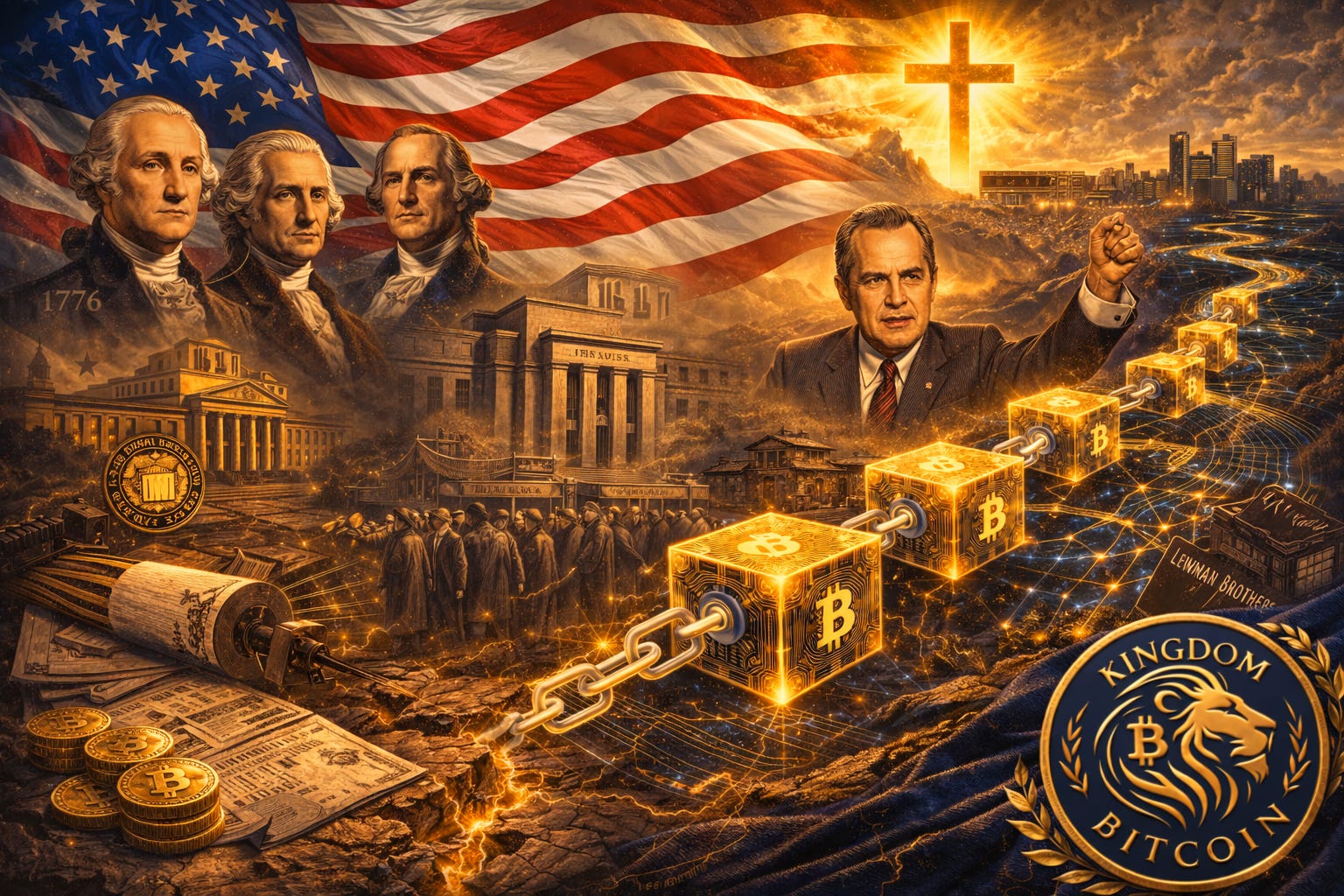
Series Throughline
America was not founded on the assumption that men are good.
It was founded on the assumption that men are fallen.

The Founders built restraint because they believed power tempts.
Scripture declares, “For there is nothing covered, that shall not be revealed; neither hid, that shall not be known.” - Luke 12:2.

From the Continental collapse to the creation of the Federal Reserve, from the Great Depression to the closing of the gold window in 1971, and from 2008 to today, every monetary era has been tested under pressure.

Inflation exposed weakness. Elasticity expanded power. Contraction revealed fragility. Bailouts exposed moral hazard.

When money can be altered quietly, trust erodes slowly.
When trust erodes, control consolidates.

Bitcoin does not assume virtue. It assumes temptation.

The Founders separated powers because they did not trust kings.
Bitcoin separates monetary authority because it does not trust committees.

This series is not nostalgia. It is about design under revelation.

What kind of monetary system survives when hidden things come to light?
That is the question.
The Great Depression restructured trust. 1971 redefined it.
After World War II, the Bretton Woods system established a new global monetary order. The United States would anchor the world. The dollar would be pegged to gold at $35 per ounce. Other currencies would be pegged to the dollar.
It was not a pure gold standard. It was a gold exchange standard. Redemption was limited to foreign governments and central banks. But the promise was clear: the dollar was convertible into something tangible.
Measurement still had an anchor.
For a time, it worked. The United States emerged from war economically dominant. Gold reserves were strong. The dollar became the world’s reserve currency. Stability followed, however incentives never sleep.
Throughout the 1960s, U.S. fiscal spending expanded. The Vietnam War. Domestic social programs. Global commitments. Dollars flowed outward through trade deficits and foreign aid. The world accumulated dollars faster than the United States accumulated gold.
By the late 1960s, global dollar supply exceeded U.S. gold coverage at $35 per ounce. The promise remained. The math tightened.
Foreign governments began redeeming dollars for gold. Pressure mounted. Confidence strained.
On August 15, 1971, President Richard Nixon addressed the nation. He announced the suspension of dollar convertibility into gold. The move was described as temporary. It was framed as protection against speculators. It was presented as necessary stabilization.
Temporary became permanent.
The gold window closed. The Bretton Woods system effectively ended. The dollar was no longer anchored to redemption. It floated. The measuring stick broke.
Money had shifted from redemption to confidence. From convertibility to credibility. From physical constraint to narrative assurance.
This was not an overnight collapse. It was a structural shift. Gold did not vanish from existence. It vanished from obligation. The world entered the modern fiat era.
When money rests primarily on belief, credibility becomes moral currency.
Central banks became stewards not merely of liquidity, but of confidence. Inflation targets replaced redemption promises. Forward guidance replaced convertibility. Communication became policy.
None of this is cartoon villainy. It is architecture. Remember, architecture shapes incentives.
Ecclesiastes speaks with uncomfortable precision. “He that loveth silver shall not be satisfied with silver; nor he that loveth abundance with increase: this is also vanity.” - Ecclesiastes 5:10.
When money expands without physical anchor, the temptation toward abundance without satisfaction intensifies. Growth becomes expectation. Deficits become normalized. Asset prices become policy concern.
When measurement floats, discipline depends entirely on human restraint.
The Founders distrusted concentrated power because Scripture taught them about fallen hearts. Bretton Woods attempted to bind discipline to gold. 1971 untied that binding.
From that point forward, monetary policy operated without an external constraint.
Interest rates could be adjusted. Money supply could expand. Balance sheets could grow. The limits were no longer physical. They were political and reputational.
This is the moment when money became more narrative-dependent than ever before. If confidence held, the system held. If credibility wavered, volatility followed.
Inflation in the 1970s revealed the cost of loosened anchors. Paul Volcker’s rate hikes in the early 1980s revealed how painful restoration of credibility could be. The measuring stick was no longer fixed. It was managed.
The Kingdom lens cuts deeper than macroeconomics.
Only God is unchanging. “Jesus Christ the same yesterday, and today, and for ever.” - Hebrews 13:8.
Human institutions shift. Policies evolve. Incentives drift. When money depends entirely on disciplined discretion, its integrity depends on the moral fiber of those in authority.
That is not condemnation. It is anthropology. 1971 did not create sin. It removed an external constraint on it.
Bitcoin emerges decades later in this context. Bitcoin is not a return to metal. It does not ship bars across oceans. It does not peg itself to gold.
It introduces digital scarcity alongside gold. Its supply is predetermined. Its issuance schedule is transparent. Its final supply is finite. It does not float against a redemption promise. It floats against belief in its rules.
There is a critical difference. Its rules cannot be altered by executive announcement. They cannot be suspended by emergency address. They are verifiable by anyone running the protocol.
Bitcoin is not backed by gold. It is backed by constraint, energy, and computing power.
In a world where measurement became narrative-dependent, bitcoin reintroduces measurable predictability. Bitcoin does not eliminate volatility. It eliminates discretionary supply shifts. It does not eliminate human fear. It removes human alteration of issuance.
1971 broke the measuring stick. Since then, credibility has carried the burden.
The question for our generation is simple. If money depends entirely on belief in managers, what happens when belief erodes? Further, what does a monetary system look like when constraint is embedded rather than promised?
The gold window closed in 1971. The era of pure fiat began. The search for credible constraint did not end. It intensified.
Prayer
Dear Father,
You are constant when institutions shift. Teach us not to anchor our hope in floating promises. Grant us discernment to understand systems without fear and to steward resources with humility. Guard our hearts from chasing abundance without satisfaction. Shape in us integrity that reflects Your unchanging nature.
May our trust be anchored in Christ, not in fluctuating currencies.
In Jesus’ name, Amen. 🙏📖⚖️💰🟠
Very good son.