

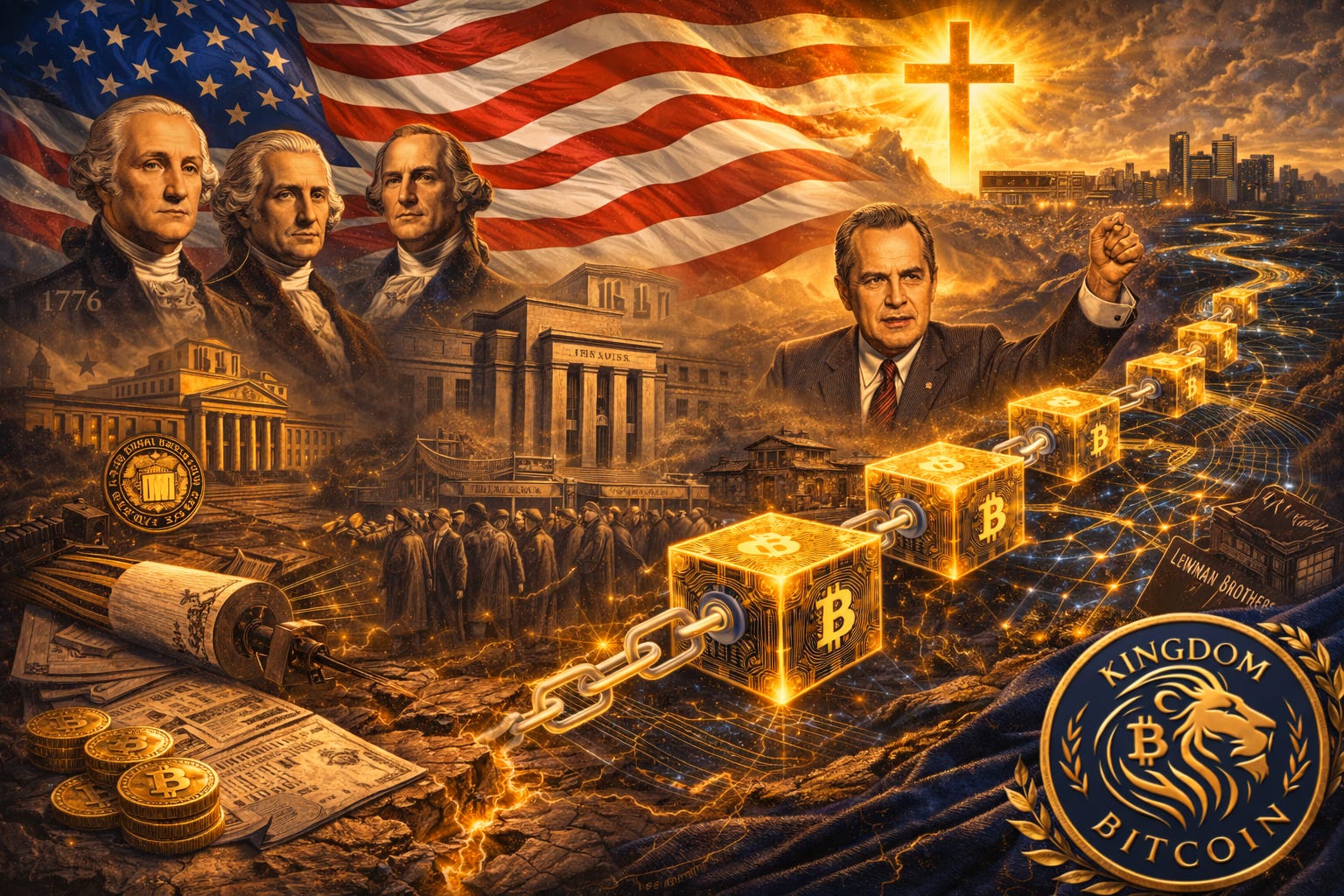
Series Throughline
America was not founded on the assumption that men are good.
It was founded on the assumption that men are fallen.

The Founders built restraint because they believed power tempts.
Scripture declares, “For there is nothing covered, that shall not be revealed; neither hid, that shall not be known.” - Luke 12:2.

From the Continental collapse to the creation of the Federal Reserve, from the Great Depression to the closing of the gold window in 1971, and from 2008 to today, every monetary era has been tested under pressure.

Inflation exposed weakness. Elasticity expanded power. Contraction revealed fragility. Bailouts exposed moral hazard.

When money can be altered quietly, trust erodes slowly.
When trust erodes, control consolidates.

Bitcoin does not assume virtue. It assumes temptation.

The Founders separated powers because they did not trust kings.
Bitcoin separates monetary authority because it does not trust committees.

This series is not nostalgia. It is about design under revelation.

What kind of monetary system survives when hidden things come to light?
That is the question.
Every monetary era eventually faces its reckoning. For modern finance, that reckoning arrived in 2008.
In March, Bear Stearns collapsed under the weight of mortgage-backed securities and evaporating liquidity. The Federal Reserve facilitated its acquisition by JPMorgan Chase, backstopping tens of billions in assets. The message was subtle but unmistakable: systemic institutions would not be allowed to fail quietly.
Then September came. On September 15, 2008, Lehman Brothers filed for bankruptcy with roughly $639 billion in assets. It remains one of the largest bankruptcies in American history. Markets convulsed. Counterparties froze. Confidence disintegrated across global credit markets.
Within days, American International Group (AIG) required a Federal Reserve liquidity facility that would eventually total up to $85 billion. What had been described as contained became systemic. What had been framed as isolated became structural.
In October, Congress authorized the Troubled Asset Relief Program (TARP) with up to $700 billion available to stabilize the financial system. Twenty-five banks failed in 2008 alone. The following year would see many more.
Losses concentrated. Consequences socialized.
Shareholders were wiped out in some cases. Executives departed with reputations bruised. But depositors were protected. Large institutions were backstopped. The system was preserved through extraordinary intervention.
This is not a simplistic condemnation. Panic required response. The collapse of the banking system would have devastated households far beyond Wall Street.
Something deeper shifted. When rules bend for the powerful, trust dissolves.
The phrase “Too Big To Fail” entered the public vocabulary not as academic jargon but as lived reality. If failure threatens systemic stability, it will be managed. If risk scales high enough, it will be absorbed collectively.
Moral hazard moved from theory to experience.
Then, quietly, in late October 2008, an anonymous figure under the name Satoshi Nakamoto released a nine-page whitepaper titled “Bitcoin: A Peer-to-Peer Electronic Cash System.”
It was not a press conference. It was not a bailout package. It was a protocol.
On January 3, 2009, the first block of the Bitcoin network was mined. Embedded within that genesis block was a newspaper headline from The Times: “Chancellor on brink of second bailout for banks.”
That was not marketing. It was commentary carved into code.
While central banks expanded balance sheets, a parallel system began running. While liquidity facilities multiplied, a fixed issuance schedule activated. While discretion managed crisis, mathematics enforced constraint.
“For nothing is secret, that shall not be made manifest; neither any thing hid, that shall not be known and come abroad.” - Luke 8:17
The financial crisis did not create greed. It revealed leverage. It did not invent interconnectedness. It exposed fragility. It did not suddenly introduce moral hazard. It made it visible.
When revelation meets concentrated power, systems either reform or harden.
Regulatory frameworks tightened after 2008. Capital requirements increased. Stress tests became routine. The language of systemic risk matured while the architecture of discretion remained.
Central banks could expand balance sheets. Governments could authorize rescue facilities. Liquidity could be manufactured when necessary.
Bitcoin responded differently.
Bitcoin assumes temptation exists. It does not rely on policymakers resisting it. It minimizes discretionary supply adjustment. It distributes validation across participants rather than concentrating it in committees. It makes its rules visible and verifiable.
It does not prevent banks from failing. It does not eliminate recession. It does not stop governments from intervening.
It simply operates alongside them. Parallel systems. One managed through policy. One governed by protocol. One flexible through discretion. One constrained through code.
This is why Bitcoin has generational staying power.
Not because it is politically favored.
Not because regulators bless it.
Not because institutions adopt it.
It endures because it does not depend on their approval.
Its credibility does not rise and fall with elections. It does not require forward guidance. It does not expand supply in response to panic. It does not compress issuance to restore confidence.
Its monetary policy was finalized before it ever launched.
The Founders separated powers because they distrusted concentrated authority. The post-2008 world consolidated monetary authority to preserve stability. Bitcoin diffused monetary authority to prevent dependence.
None of this replaces the Gospel. Bitcoin does not redeem sin. It does not heal greed. It does not sanctify markets. Only Christ redeems the heart. Only the Holy Spirit produces self-control. Only truth transforms.
Systems that assume fallen nature rather than ignore it tend to endure longer. 2008 was not the end of monetary history. It was the birth of a parallel path.
Revelation led to intervention. Intervention led to expansion. Expansion led to new questions. Bitcoin did not arise from utopian idealism. It arose from disillusionment with discretionary rescue.
The crisis revealed that when systemic collapse looms, rules bend. Bitcoin was built so that its rules cannot. That difference will matter in every cycle ahead.
Prayer
Dear Lord,
You see the hidden structures behind visible crises. Guard our hearts from cynicism and from blind trust alike. Give us wisdom to navigate systems shaped by human weakness. Teach us to steward opportunity with humility and integrity. Anchor us in truth that does not fluctuate with markets or policy.
May our ultimate security rest in Christ alone. In Jesus’ name, Amen. 🙏📖⚖️🏦🟠