

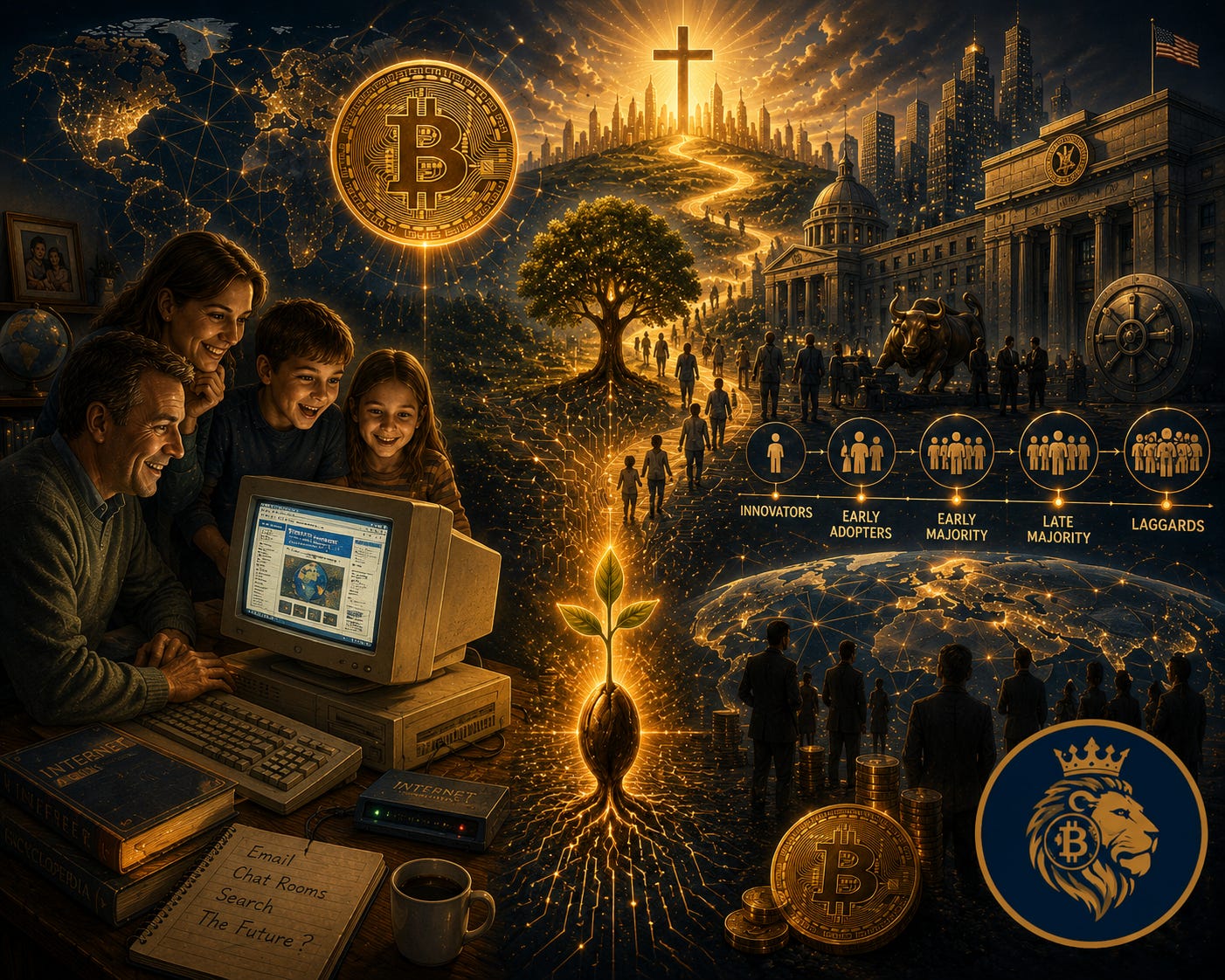
The family computer sat in the corner of the living room. It was 1997.
The monitor was as deep as it was wide, and the modem announced itself with a chorus of clicks, whistles, and static before finally connecting to something most people simply called “the Internet.”
The webpage appeared one line at a time.
Pictures loaded slowly from the top down. Every click required patience. Email still felt futuristic. Shopping online seemed strange. Most people who gathered around that glowing screen had heard about the Internet, yet almost no one in the room could have imagined streaming movies, ordering groceries from a phone, navigating with satellites, working from home, or carrying the world’s knowledge inside a device that fit into a pocket.
The Internet was already famous. It was nowhere near finished. History has a remarkable habit of confusing awareness with adoption.
The moment something becomes widely recognized, many people instinctively assume its greatest opportunity has already passed. Headlines create the illusion of maturity. Familiarity creates the illusion of completion. We hear the name often enough that we begin to believe everyone must already understand it.
Bitcoin suffers from this illusion today. Almost everyone has heard of it. Relatively few truly understand it.
Jesus once compared the Kingdom of Heaven to a mustard seed. It was the smallest seed His listeners would have known, easily overlooked and almost laughably insignificant. Yet hidden inside that tiny beginning was an architecture of astonishing future growth. The seed was never impressive because of its size. It was remarkable because of what it would eventually become.
Bitcoin is not the Kingdom of God. The comparison ends there.
That said, the principle remains profoundly helpful. Human beings consistently underestimate beginnings. We assume that if something appears small, incomplete, or unfamiliar, it cannot possibly reshape the world. Then, almost without noticing, yesterday’s curiosity quietly becomes today’s infrastructure.
Every transformative technology follows a similar pattern. First come the innovators. The people willing to look foolish. Then come the early adopters. They see possibility before convenience exists. Only much later does the early majority arrive. They wait until the roads are smoother, the tools are simpler, and enough uncertainty has disappeared to make participation feel responsible. After that comes the late majority, followed by those who adopt only because the rest of the world has already moved on without them.
Bitcoin is still somewhere between those early chapters.
That surprises many people because media attention creates the appearance of saturation. Bitcoin has appeared on financial news, political debate stages, podcasts, YouTube channels, and dinner tables around the world. It feels familiar.
Recognition, however, is not completion. The American republic teaches a similar lesson.
The Declaration of Independence made America famous almost overnight. But independence did not instantly create a mature republic. The Articles of Confederation proved insufficient. The Constitution had yet to be written. The Bill of Rights had not been adopted. The institutions capable of carrying liberty still required years of careful construction.
Recognition arrived long before stability.
The same pattern appears repeatedly throughout history. Electricity was celebrated before every home had power. Automobiles became famous before highways connected the country. Credit cards existed long before people trusted them for everyday purchases. The smartphone was introduced years before it became difficult to imagine life without one.
The infrastructure always trails the invention. Bitcoin is no different.
Today, most people still purchase bitcoin through centralized exchanges. Many leave it there because self-custody feels intimidating. Businesses are only beginning to integrate bitcoin into treasury strategies. Layer 2 technologies continue making payments faster, cheaper, and more practical. Financial institutions are gradually building products around it. Developers continue expanding applications most people have never heard of.
Eventually, many people may interact with Bitcoin without consciously thinking about bitcoin at all.
Few people today understand the Transmission Control Protocol that quietly moves information across the Internet. They simply send emails, stream movies, join video calls, and order dinner. The protocol became invisible because it became useful.
Mature technologies often disappear into ordinary life. Perhaps that is where bitcoin is ultimately heading. Not toward louder headlines. Toward quieter usefulness.
That perspective changes the emotional question entirely. Instead of asking whether bitcoin has become too well known, perhaps we should ask whether the world has actually integrated it into everyday life. Those are very different questions.
Most people overestimate how late they are because they confuse awareness with adoption. The distinction matters because awareness creates attention. Adoption changes behavior.
The two are separated by years of education, infrastructure, regulation, trust, and ordinary people slowly discovering that what once seemed unusual has become practical.
The farmer understands this instinctively. One plants. Another waters. God gives the growth.
Paul reminded the Corinthian church that growth unfolds according to God’s timing rather than human impatience. Zechariah warned God’s people not to despise small beginnings because the Lord delights in watching faithful work unfold. Habakkuk reminded Israel that vision often waits for its appointed time before revealing its full purpose.
God seems remarkably comfortable with gradual growth. We rarely are. Perhaps that explains why we struggle to recognize adoption while it is still happening.
Wall Street has begun paying attention.
Large institutions that once dismissed bitcoin now study it, build products around it, and quietly accumulate exposure. Pension funds, asset managers, corporations, and even governments have begun asking questions they once mocked.
The laughter has largely disappeared. Curiosity has replaced it. That should not produce arrogance. It should produce perspective. Because the truly interesting question is no longer whether bitcoin has become famous.
The question is what happens when institutions, corporations, and eventually nations begin treating absolute scarcity not as an experiment, but as a strategic asset.
Kingdom Principle 👑
God often begins His greatest works long before the world recognizes what He is building.
Faithful stewardship requires seeing beyond headlines and learning to recognize the difference between awareness and maturity. God’s work, like many lasting things, grows patiently before it becomes widely understood.
Prayer 🙏
Heavenly Father, thank You for reminding us that lasting growth rarely happens overnight. Give us patience to trust Your timing, wisdom to recognize faithful beginnings, and humility to avoid confusing popularity with maturity.
Teach us to become people who value steady growth, thoughtful preparation, and faithful stewardship more than excitement or applause. May our lives reflect the quiet confidence that comes from walking with Jesus and trusting Your purposes, even when the world cannot yet see what You are building.
In Jesus’ name, Amen. 🙏📖🌱₿🕊️👑