

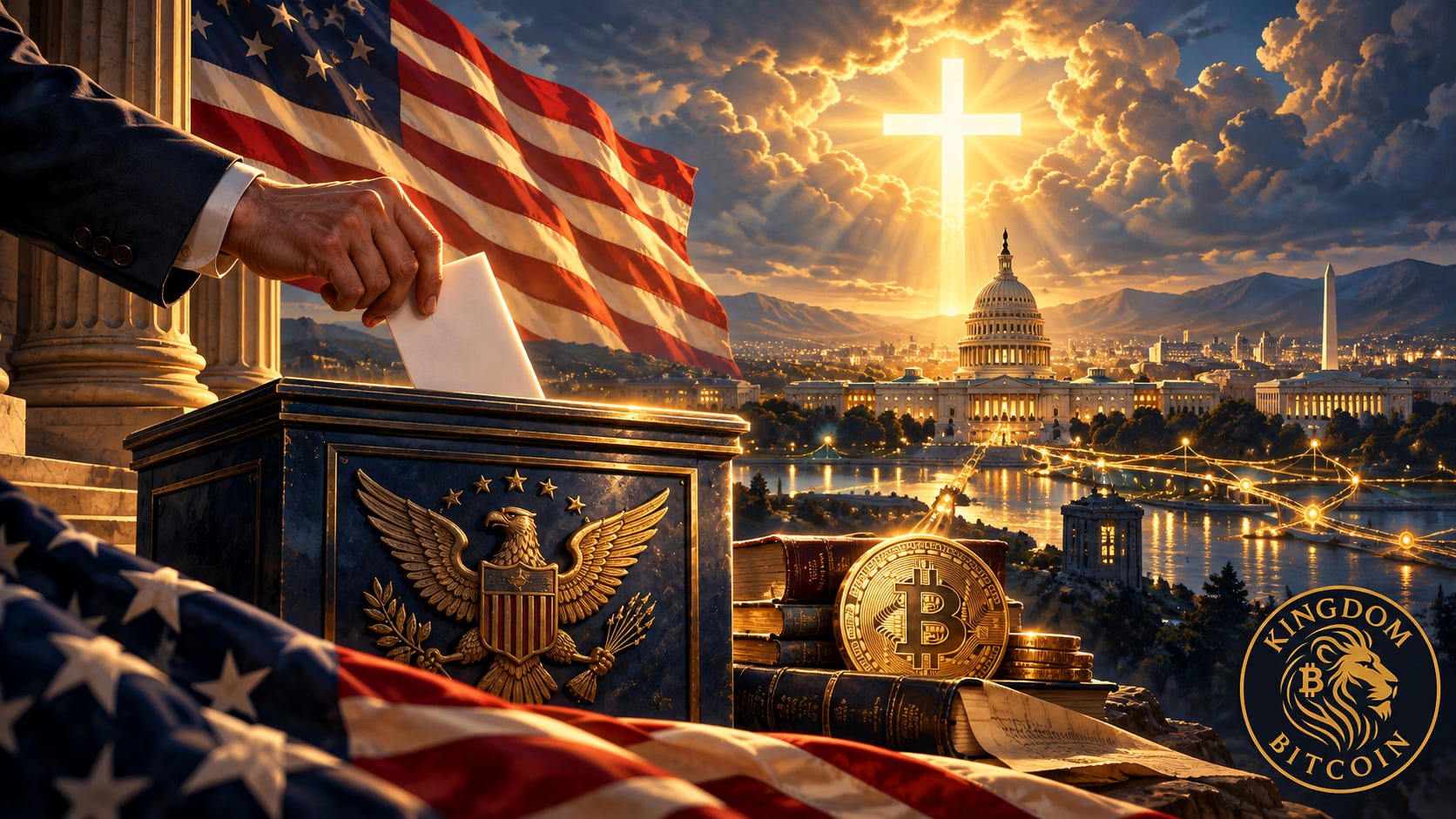
Election Day is not merely about which party wins office. It is about what kind of country we intend to preserve and what principles we are willing to hand to the next generation. America began with an extraordinary proposition: our rights do not originate with government. The Declaration says human beings are endowed by their Creator with unalienable rights and that government derives its just powers from the consent of the governed. That order matters because a government that treats rights as its gift will eventually claim the authority to redefine them.
Christianity is foundational to how I understand that American moral architecture. America was not established as a national church, but neither was it built on moral emptiness. George Washington called religion and morality indispensable supports of political prosperity, and the Founding generation repeatedly connected liberty with virtue and responsibility. Proverbs 14:34 says, “Righteousness exalts a nation, but sin condemns any people.” The Holy Spirit forms the character that no Constitution, legislature, or political party can manufacture.
Scripture is also clear-eyed about political power. Romans 13 recognizes the legitimate role of government, while 1 Samuel 8 warns what happens when people place too much confidence in centralized authority. Samuel tells Israel that the king will take fields, vineyards, servants, flocks, and the fruit of their labor. Government has a proper assignment, but it is not God, parent, church, employer, and provider rolled into one. Limited government is not the absence of order. It is government disciplined enough to know where its authority ends.
That same God-given freedom should protect our ability to work, create, own, invest, and build. I believe unapologetically in capitalism because it gives ordinary people room to cultivate what has been entrusted to them. Jesus’ Parable of the Talents is not a lecture on modern economics, but its stewardship principle is unmistakable. Something is entrusted, productive action matters, fear can bury potential, and the steward ultimately gives an account. Talent should not be buried.
Capitalism creates the field where that cultivation can become useful to others. An idea can become a company, savings can become investment, and investment can become employment, innovation, and opportunity. A person can fail, learn, begin again, and build something his or her parents could not have imagined. The American Dream is not a government promise that everyone will finish in the same place. It is the freedom to begin somewhere and work toward somewhere better. That freedom has attracted generations of builders because it gives human creativity room to breathe.
That is why I vehemently oppose both the economic and political vision advanced by the Democratic Socialists of America. DSA says capitalism should be replaced by democratic socialism, advocates collective ownership of key economic drivers, and calls for public ownership of the largest corporations and essential industries. That is not merely a debate over a tax rate or the size of one government program. It is a competing vision for where economic power and responsibility should live. I believe economic decisions are safer when dispersed among households, workers, customers, entrepreneurs, and investors than when concentrated in political institutions.
At its core, I see the DSA vision as elevating government and collective institutions into roles God ordinarily entrusts to individuals, families, churches, businesses, and local communities. China offers a sobering warning about what can happen when state authority becomes powerful enough to subordinate nearly every independent institution to political ideology. Religious organizations are expected to affirm Communist Party leadership, conform their practices to state priorities, and operate within boundaries established by political officials. Churches lose the freedom to govern themselves, clergy are supervised, and independent worship becomes a threat to the state rather than an expression of conscience. The freedom to worship God, cultivate our God-given talents, provide for our families, and organize our communities must never become subordinate to political ideology.
This is bigger than Right versus Left. It is right versus wrong. I believe Democratic Socialism is wrong and fundamentally un-American because it subordinates private property, free enterprise, personal responsibility, limited government, and the freedom to build to expanding political control.
The American experiment has never promised equal outcomes administered from above. It has promised room for free people to strive, build, serve, rise, and begin again. Replacing that aspiration with permanent dependency would not improve the American Dream. It would slowly surrender it.
Compassion is central to Christianity, but biblical compassion is never separated from truth and accountability. Ephesians 4:28 tells the believer to work so that he may have something to share with those in need. Productive work and generosity belong together. Government has a legitimate role in protecting the vulnerable and administering justice, but it should not replace the family nor individual responsibility as the first answer to every human need. Compulsory redistribution may fund legitimate public obligations, but it should never be confused with Christian generosity, which requires sacrifice, love, and moral agency. The question is not whether we care for people. The question is whether compassion ultimately strengthens human agency or steadily replaces it with dependence on the state.
That question is not theoretical. The Soviet central-planning system suppressed market prices, weakened competition, created poor incentives, and produced recurring shortages and low productivity. Venezuela’s economy contracted by more than 75 percent between 2013 and 2021 amid severe mismanagement, hyperinflation, collapsing investment, currency depreciation, and a debt crisis. In Cuba, rigid controls produced shortages and queues. These countries have different histories, but their experiences leave a recurring warning. When political institutions concentrate too much economic authority, information becomes distorted, initiative weakens, and ordinary households pay the price.
Bitcoin enters this argument through the same question of concentrated power. Bitcoin does not tell us how to vote, nor should America be governed like a monetary network. Its design does, however, ask how much authority any one participant should possess and what protects everyone else when that authority is abused. Bitcoin separates roles, makes its core rules visible, protects digital ownership through cryptography, and makes arbitrary monetary changes extraordinarily difficult. It does not assume that every participant will behave perfectly. It builds verification and constraint around the reality that they will not.
James Madison approached political power with a similar instinct. In Federalist No. 51, he argued that because men are not angels, government must control the governed and then be obliged to control itself. The Constitution divided political power because human beings are creative and capable, but also fallen and prone to ambition. The Constitution places checks around political authority. Capitalism disperses economic decision-making. Bitcoin places verification and constraint around monetary power. These are different systems serving different purposes, but each begins with a sober understanding of human nature. Christianity sits above all three by telling us what freedom is for.
That is the thread connecting my faith, my conservatism, my defense of capitalism, my love for America, and my continued belief in Bitcoin. Human beings possess enormous creative potential because we are made in the image of God. We also remain capable of pride, greed, deception, and domination. Power should therefore have limits, property should be protected, rules should be understandable, and people should retain room to cultivate the talents God has placed in their hands. Freedom is not the absence of responsibility. It is the opportunity to exercise responsibility without unnecessary control from above.
Jesus is not on the ballot today. He remains King regardless of the returns, and the government rests upon His shoulders regardless of which party celebrates tonight. Yet the freedoms we steward are affected every time Americans choose leaders, policies, and economic systems. I want to preserve an America that remembers the Source of its rights, rewards work, protects ownership, encourages builders, rejects dependency as a national ambition, and remains confident enough in its Christian inheritance to speak of it without apology. Freedom survives only when each generation chooses to protect it.
America’s next 250 years will not be secured by nostalgia for 1776, campaign slogans, or another promise that government can remove every hardship. They will be secured by citizens who remember that rights come from God, political power requires restraint, freedom requires character, enterprise requires room to build, and money requires honest rules. Elections choose leaders for a season, but principles determine what survives the season. The ballot is an instrument of stewardship.
Today the ballot is in our hands. The stewardship is too. What will you choose?
Kingdom Principle 👑
Freedom flourishes when God remains above government, power remains constrained, property remains protected, and people remain free to cultivate what has been entrusted to them.
Capitalism is more than an economic scoreboard to me. At its best, it creates room for human agency. A person can turn skill into work, work into savings, savings into investment, investment into enterprise, and enterprise into opportunity for someone else. That is the American Dream at its strongest: not government guaranteeing identical outcomes, but a country protecting the freedom to pursue extraordinary ones.
That does not make capitalism our god. Jesus Christ holds that place alone. It means we recognize that government should protect the field rather than attempt to play every position on it.
Bitcoin offers a modern expression of the same suspicion of concentrated authority. Its lesson is not that every institution should become decentralized. It is that rules matter, ownership matters, verification matters, and systems become more durable when powerful participants cannot casually rewrite the terms for everyone else.
The Founders understood that politically. Capitalism expresses it economically. Bitcoin explores it monetarily.
Christianity tells us why the freedom is worth preserving in the first place.
Prayer 🙏
Heavenly Father, thank You for this extraordinary country and for the generations who sacrificed to preserve its freedom. Thank You for the ability to worship, speak, own, build, invest, work, vote, raise our families, and pursue the gifts You have placed within us. Help us never become so accustomed to liberty that we forget how rare it has been throughout human history.
Give America wisdom to reject systems that promise security by surrendering increasing amounts of responsibility and freedom to government. Give us compassion without dependency, prosperity without greed, strength without arrogance, and markets shaped by honesty, service, responsibility, and human dignity. Give us courage to defend our Christian convictions while protecting the freedom of conscience that allows faith itself to remain free.
Holy Spirit, form the character that self-government requires. Keep Jesus Christ above our politics, capitalism, Bitcoin, wealth, technology, and nation. As America enters its next 250 years, help us preserve what is worthy, correct what is broken, cultivate what You have entrusted to us, and leave our children more freedom rather than more dependency.
The future belongs to You. The stewardship belongs to us. In Jesus’ name, Amen. 🙏📖🇺🇸🗳️🗽⚖️🏠💼📈₿🕊️👑