

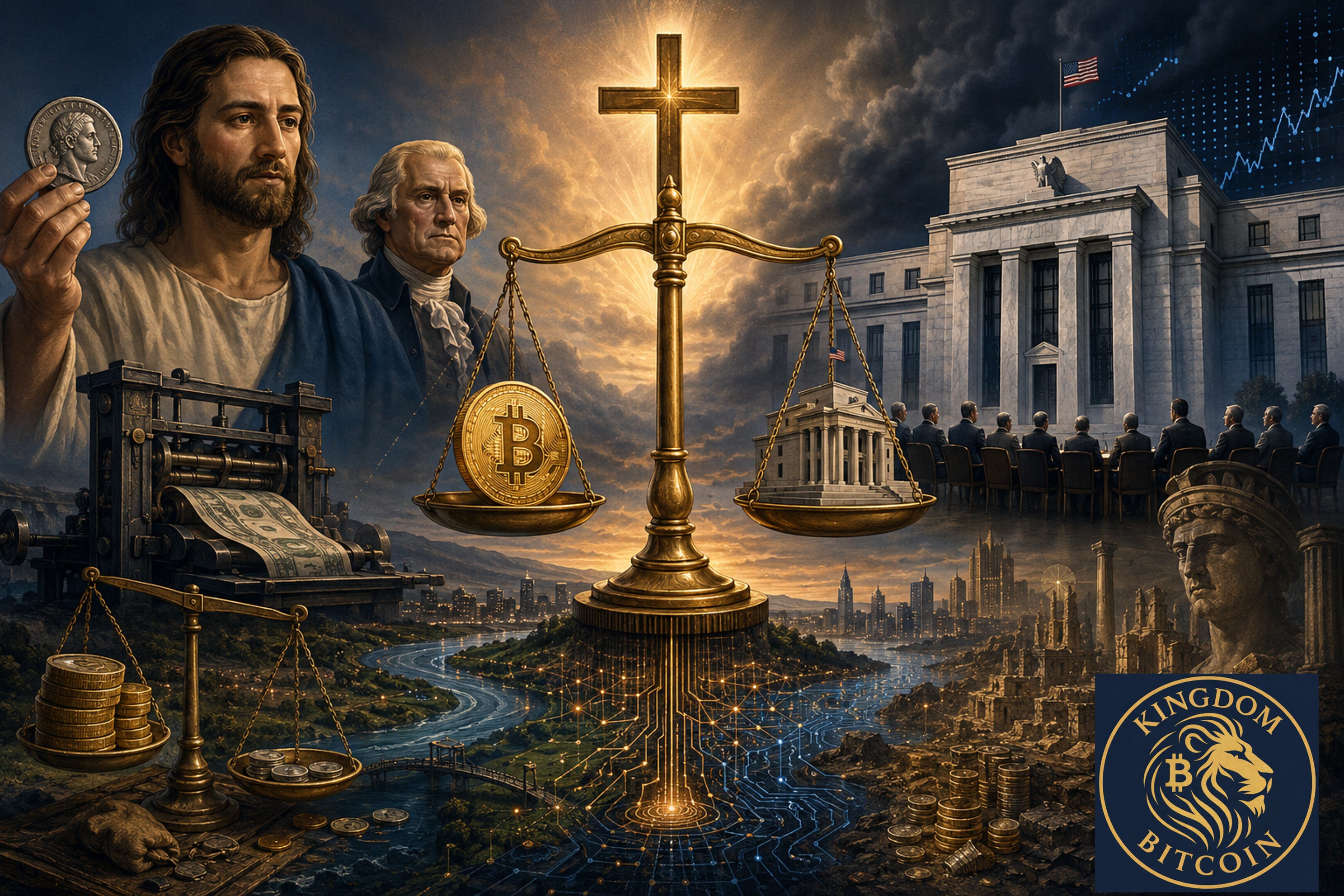
Proverbs, Inflation, and the Hidden Tax
The merchant smiled as he completed the transaction. His customer smiled too. Both believed they had conducted an honest exchange.
Grain changed hands. Silver changed hands. The market continued humming with activity beneath the Jerusalem sun. Nothing appeared unusual. No argument erupted. No accusation was made. No theft had occurred, at least not in any way visible to the human eye.
Yet one man walked away richer than he should have been. The other walked away poorer than he realized. The difference was hidden inside the scale.
The merchant had altered the weights. Not enough to attract attention. Not enough to trigger suspicion. Just enough to tilt every transaction slightly in his favor. Every customer lost a little. Every sale transferred a small amount of value from one person to another. No single transaction was large enough to provoke outrage. The deception worked precisely because it was subtle.
That is why Scripture speaks so strongly about scales.
“A false balance is an abomination to the Lord, but a just weight is His delight.” (Proverbs 11:1)
Notice the language.
The dishonest merchant is not merely accused of poor business ethics. The false balance is called an abomination. Throughout Scripture, that word is reserved for practices that violate the very order God intends for human flourishing. Honest commerce depends upon honest measurement. The moment measurement becomes corrupted, trust begins to erode.
The scale matters because the scale determines reality. If the measurement cannot be trusted, neither can the transaction.
The ancient world understood this intuitively. Merchants, farmers, laborers, and families depended upon shared standards. Everyone needed confidence that a pound weighed a pound and that a shekel represented a shekel. Civilization itself rested upon confidence in the measurement.
Thousands of years later, the scales remain. Only the technology has changed.
Most people no longer buy grain using silver weights. They buy groceries with debit cards, direct deposits, and digital transactions. Yet beneath the modern economy lies the same foundational requirement. We still depend upon honest measurement. We still trust that the money we earn today will preserve its value tomorrow. We still assume the ruler remains unchanged.
But what happens when the ruler changes? Not suddenly. Quietly. Gradually. Almost invisibly. A dishonest scale steals slowly enough that most people never realize they have been robbed.
This is where inflation enters the story.
Inflation is often described as rising prices. That definition is not entirely wrong, but it misses something important. Rising prices are usually the symptom. The deeper issue is the changing value of the measuring stick itself.
Imagine spending thirty years saving for retirement. You skip vacations. You delay purchases. You work long hours. You make sacrifices because you believe the value of your labor can be stored for the future. Then one day you discover that the dollars you saved purchase significantly less than they once did.
Nothing was physically taken from you. Your bank account still shows the same number. Yet something has undeniably changed. The purchasing power attached to those dollars has diminished. Your labor has been diluted. The scale has moved.
For most of human history, governments discovered that altering the scale was easier than solving difficult problems. Kings shaved precious metals from coins. Emperors mixed silver with cheaper metals. Rulers throughout history learned that creating more units of money often felt less painful than raising taxes or reducing spending.
The mechanism evolved. The temptation never did.
Modern central banks do not clip silver from coins. Instead, they expand the money supply through monetary policy. During periods of economic stress, new money enters the system through mechanisms such as quantitative easing, asset purchases, and lending programs. These policies are often introduced with good intentions. Policymakers seek stability, growth, and economic support during difficult periods.
The issue is not motivation. The issue is mathematics.
When more units of money chase the same goods and services, the value of each unit tends to decline. The process feels abstract until it reaches everyday life. Groceries cost more. Housing costs more. Education costs more. Healthcare costs more. The family budget begins stretching further and further simply to maintain the same standard of living.
Most people blame the price tag. Few stop to examine the ruler. The prophet Amos did.
“Hear this, you who trample the needy... making the ephah small and the shekel great, dealing deceitfully with false balances.” (Amos 8:4-5)
The brilliance of Amos is that he understood who suffers first when measurement becomes dishonest.
Not the wealthy. Not those closest to the source of newly created money. The poor. The laborer. The retiree. The family attempting to save. The people whose wealth exists primarily in the form of currency rather than assets.
Inflation rarely announces itself as theft. It disguises itself as policy. That is why it can persist for so long.
John Adams once observed that much of society’s confusion arose from ignorance surrounding coin, credit, and circulation. His observation remains surprisingly relevant. Most people understand their paycheck. Few understand the monetary system surrounding it. Most understand prices. Few understand the measurement beneath those prices.
Yet the Bible consistently returns our attention to the measurement.
Proverbs 20:10 declares, “Unequal weights and unequal measures are both alike an abomination to the Lord.”
Leviticus commands honest scales. Amos condemns false balances. Again and again, Scripture reveals God’s concern for honest measurement.
Why? Because measurement is ultimately about truth. God is a God of truth. A just scale reflects reality. A dishonest scale distorts reality.
This is where bitcoin presents a challenge unlike anything seen before in monetary history.
Bitcoin does not promise prosperity. It does not guarantee wealth. It does not eliminate economic cycles.
What it does offer is a fixed monetary supply governed by transparent rules rather than ongoing human discretion. Twenty-one million coins. No emergency meetings. No unexpected dilution. No authority capable of changing the issuance schedule because circumstances became difficult.
Whether one ultimately embraces Bitcoin or not, the underlying question remains profound.
What if money itself should be measured by a standard that cannot be altered? What if the ruler should remain fixed? What if honest scales are not merely a technological innovation, but a moral principle?
The merchant in Jerusalem believed his deception was too small to matter. Transaction by transaction, he slowly proved himself wrong. Civilizations often make the same mistake. The scale moves a little. Then a little more. Then a little more.
Eventually an entire generation wonders why life feels more expensive even though everyone insists the measurement remains the same.
The Bible’s answer is surprisingly direct.
God delights in honest scales because honest scales tell the truth. And perhaps that leads us to the next question.
If every civilization eventually faces the temptation to manipulate the measurement, what did America’s Founders understand about money that we have forgotten?
Kingdom Principle 👑
God delights in honest measurement.
Throughout Scripture, God repeatedly connects justice with honest scales and honest weights. Truth is not merely a spiritual principle. It is also an economic one. Whether in business, leadership, or money, God is honored when measurement reflects reality. Faithful stewardship begins with a commitment to truth, even when dishonesty appears more convenient.
Prayer 🙏
Heavenly Father, thank You for being a God of truth. In a world filled with shifting standards and changing measurements, help us build our lives upon what is honest, just, and lasting.
Give us wisdom to steward our resources faithfully and discernment to recognize when the scales around us have become distorted. Teach us to value truth more than convenience and integrity more than gain. May our financial decisions reflect Your character and may we become people who delight in honest measurement just as You do.
In Jesus’ name, Amen. 🙏⚖️📖₿🕊️👑