

Kevin Warsh and the Return of the Monetary Question
On June 17, 2026, twelve people gathered around a conference table in Washington, D.C. There were no campaign rallies, no cheering crowds, and no breaking-news banners announcing the significance of the moment. Most Americans never noticed it happened. Yet before the day was over, the value of stocks, bonds, real estate, currencies, commodities, retirement accounts, and Bitcoin holdings around the world had shifted because of decisions made inside that room. The participants were members of the Federal Open Market Committee, the body responsible for setting monetary policy in the world’s largest economy. At the head of the table sat Kevin Warsh, presiding over his first meeting as Chairman of the Federal Reserve.
That fact alone should make us pause. In an age obsessed with political theater, we tend to assume power resides where attention is concentrated. We watch presidential debates, election campaigns, and congressional hearings because they are visible. Yet some of the most consequential decisions in modern society occur far from public view. A handful of economists and central bankers gather around a table, review data, debate forecasts, and issue a statement. Within minutes, markets react. Mortgages are repriced. Business investments are reconsidered. Governments reassess their borrowing costs. Capital begins moving across the globe in search of opportunity and protection.
The modern world has become so accustomed to this arrangement that we rarely stop to ask whether it is remarkable. We simply accept it as part of the landscape, much as previous generations accepted kings, emperors, or ruling councils. Yet Scripture has a habit of forcing us to ask questions that culture no longer thinks to ask. Whenever significant authority is concentrated into the hands of a few people, the Bible invites us to examine not only the character of those who hold that authority, but the nature of the authority itself. Who possesses it? How was it obtained? What limits restrain it? And should any human institution possess such influence over the lives of so many?
These are not modern questions. They are ancient ones. Long before there was a Federal Reserve, before there were central banks, stock exchanges, or government bonds, rulers discovered a truth that has shaped civilization for thousands of years. Whoever controls the measurement often influences everything being measured. Whoever controls the scale influences every transaction. Whoever controls money eventually influences an entire society. The names have changed throughout history, but the temptation has remained remarkably consistent. Pharaoh encountered it in Egypt. Nebuchadnezzar encountered it in Babylon. Caesar embodied it in Rome. Every empire eventually discovers that power over money is power over people.
That is why one of the most important conversations about money in human history took place not inside a treasury or royal palace, but in the Temple courts of Jerusalem. The Pharisees and Herodians approached Jesus with what they believed was an impossible dilemma. If He endorsed paying taxes to Rome, He would alienate many of His Jewish followers who lived under Roman occupation. If He opposed the tax, He could be accused of rebellion against the empire. It was a carefully designed trap disguised as a sincere question.
“Tell us then,” they asked, “what is your opinion? Is it right to pay the imperial tax to Caesar or not?”
Jesus did not answer immediately. Instead, He asked for a coin.
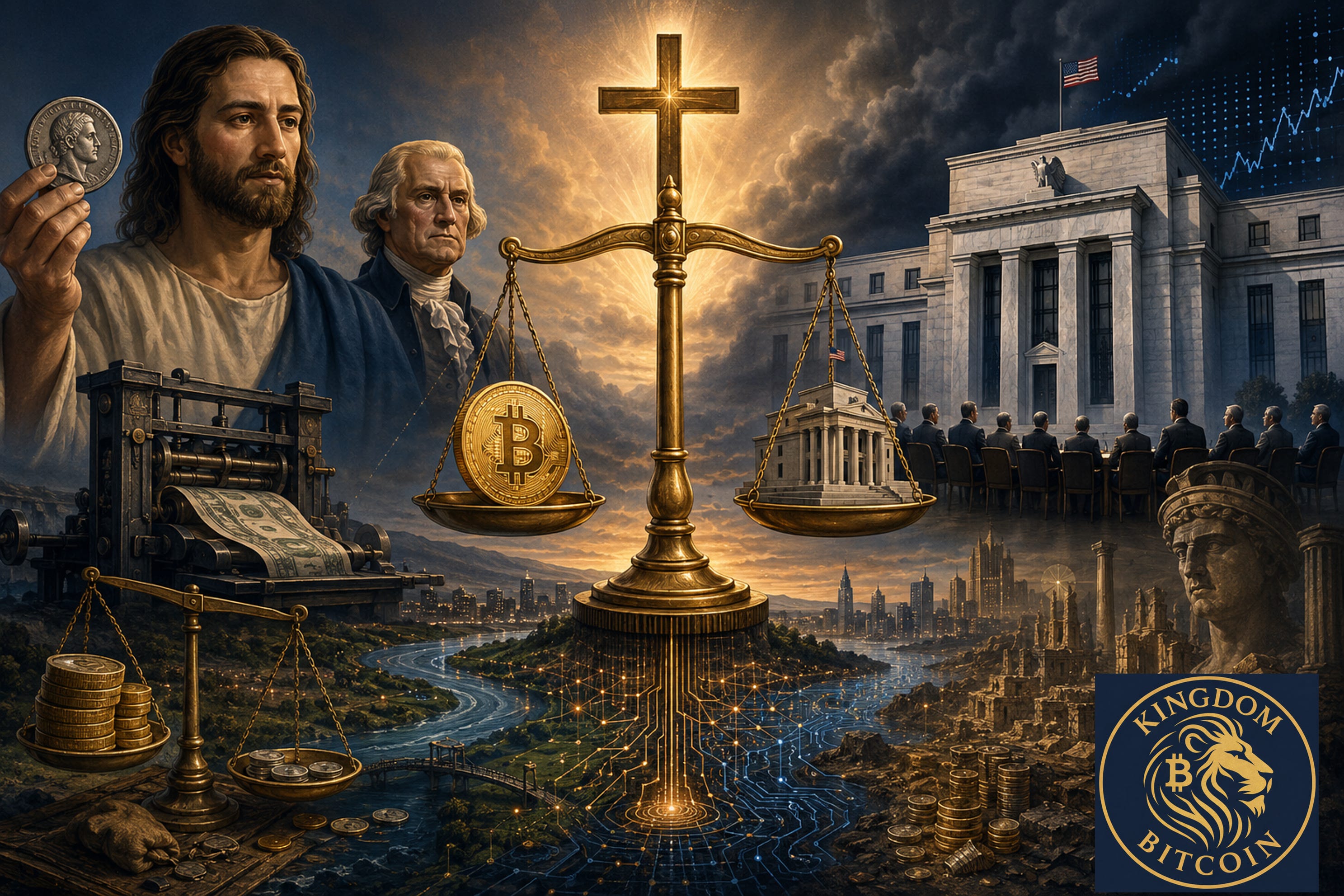
Someone handed Him a denarius, the common silver coin of the Roman Empire. To modern readers, it may seem like an ordinary object. To those standing before Him, however, the coin represented something much larger than currency. Stamped into the silver was the image of Tiberius Caesar, the most powerful man in the known world. The coin served as a constant reminder of Rome’s authority. It facilitated commerce, enabled taxation, and connected distant provinces to the economic machinery of the empire. Every transaction carried an implicit message: Rome rules here.
Holding the coin before the crowd, Jesus asked a simple question. “Whose image is this?” “Caesar’s,” they answered.
Then came a response that has echoed through two thousand years of history.
“Render therefore unto Caesar the things that are Caesar’s, and unto God the things that are God’s.”
Most discussions of this passage focus on taxation, citizenship, or political responsibility. Yet hidden within Christ’s answer is a deeper question that every generation must eventually confront. What exactly belongs to Caesar? More specifically, how much belongs to Caesar? The coin bore Caesar’s image, but human beings bear God’s image. One belonged to an earthly kingdom. The other belonged to an eternal one. The distinction is not incidental. It is foundational.
Every empire eventually attempts to blur that distinction. Every empire seeks authority beyond its proper boundaries. Every empire begins to believe that because it can influence commerce, it can define value itself. The temptation is as old as Eden. Humanity has always desired the power to determine what is good, what is valuable, and what is true apart from God’s authority.
This is why Kevin Warsh is not actually the central character in our story. Jerome Powell was not the story before him. Alan Greenspan was not the story before that. The deeper story is the institution itself and, beneath the institution, the idea that a small group of experts can help determine the price of money for hundreds of millions of people. Whether those experts are wise or foolish is not the primary question. The deeper question is whether any group of fallen human beings should possess authority over the ruler itself.
Bitcoin enters this story because it challenges one of humanity’s oldest assumptions. Throughout history, we have largely accepted that money requires rulers. Kings oversee it. Governments issue it. Central banks manage it. Committees guide it. Bitcoin proposes an alternative possibility. What if money could operate according to rules rather than rulers? What if the scale itself could not be adjusted according to political priorities, economic emergencies, or human preferences? What if trust could be distributed instead of concentrated?
Those questions explain why bitcoin reacts to Federal Reserve decisions while simultaneously challenging the assumptions upon which institutions like the Federal Reserve are built. One system ultimately relies upon human judgment. The other relies upon transparent rules applied equally to everyone. One requires ongoing trust in decision-makers. The other attempts to minimize the need for trust altogether.
Thomas Jefferson understood the danger long before the invention of bitcoin. He warned that banking institutions could become more dangerous than standing armies because he recognized a truth that Scripture repeatedly teaches. Power is safest when it is limited. Human beings are capable of extraordinary wisdom and extraordinary innovation, but they are also fallen. The Bible never forgets either reality. It celebrates human creativity while remaining sober about human nature.
The central question of monetary history, therefore, is not whether money can be created. It is whether fallen human beings can be trusted with the scale. The twelve people who gathered in Washington this week are not villains. They are stewards attempting to navigate a remarkably complex world. Yet the existence of wise stewards does not eliminate the need to ask whether any steward should possess authority over the ruler itself.
The denarius bore Caesar’s image. The human soul bears God’s. Confusing the two has been the temptation of every empire, every ruler, and every age. As we begin this journey together, that is the question we will follow from Jerusalem to Washington, from Rome to bitcoin, and from ancient scales to digital money.
The issue is not merely who controls the currency.
The issue is who controls the ruler.
Kingdom Principle 👑
Stewardship begins with understanding who owns what.
Jesus reminded His listeners that Caesar’s image appeared on the coin, but God’s image appeared on the person. That distinction still matters today. Everything we possess, from our income and investments to our talents and opportunities, ultimately belongs to God. Wise stewardship begins when we stop viewing ourselves as owners and start seeing ourselves as faithful managers of what He has entrusted to our care.
Prayer 🙏
Heavenly Father, thank You for entrusting us with resources, opportunities, and responsibilities. Give us wisdom to steward them faithfully and humility to remember that everything we have ultimately belongs to You.
We pray for Kevin Warsh, the Federal Reserve, and all those entrusted with positions of authority. Grant them wisdom, integrity, and discernment. Above all, help us place our trust not in governments, institutions, or markets, but in You alone. May we honor You with every financial decision we make and steward well what You have placed in our hands.
In Jesus’ name, Amen. 🙏⚖️₿📖🕊️👑