

What the Founders Believed About Money
The summer air in Philadelphia hung heavy over the city.
Windows stood open in an effort to capture whatever breeze might pass through the Pennsylvania State House. Horses clattered across cobblestone streets outside while, inside, a small group of men argued about the future of a nation that barely existed.
The year was 1787.
The American Revolution had been won, but victory had not brought stability. The young republic was burdened by debt, political division, and deep uncertainty about how a free people should govern themselves. The Articles of Confederation were failing. States competed against one another. Economic confusion was widespread. Confidence in government remained fragile.
The men gathered in Philadelphia were attempting something unprecedented. They were not merely drafting laws. They were designing a framework capable of restraining power itself.
What made the task especially difficult was that they carried fresh memories of a painful lesson.
They had lived through the collapse of the Continental Currency.
During the Revolutionary War, the Continental Congress printed enormous quantities of paper money to finance the struggle against Britain. At first the currency served its purpose. Over time, however, confidence deteriorated. More notes were issued. Their value declined. Prices rose. Savings evaporated. Before long, the phrase “not worth a Continental” entered the American vocabulary as shorthand for something virtually worthless.
The experience left scars.
The Founders had witnessed firsthand what happened when governments gained the ability to create money without meaningful restraint. They had seen how quickly confidence could disappear once the measurement itself became unstable. The lesson was not theoretical. It was personal. Farmers felt it. Merchants felt it. Soldiers felt it. Families who had sacrificed for independence felt it.
That memory sat quietly in the room as the Constitution was debated.
Modern discussions often portray the Founders as divided primarily by ideology. Hamilton favored one vision. Jefferson favored another. Madison occupied his own position. Franklin offered still another perspective. While those differences certainly existed, they shared something deeper.
A profound skepticism of concentrated power.
The Founders did not distrust government because they hated government. They had just fought a war to create one. Their concern was rooted elsewhere. They understood human nature.
Scripture had been teaching the same lesson for centuries.
In 1 Samuel 8, Israel demanded a king so they could be like the surrounding nations. The request appeared reasonable. It sounded practical. Yet God warned the people what centralized authority would eventually do. The king would accumulate power. He would take sons for his armies. He would take daughters for his service. He would take fields, vineyards, and resources. What began as a desire for security would eventually produce dependency.
The warning was not about one particular king. It was about human nature.
Jeremiah would later summarize the problem with remarkable simplicity: “The heart is deceitful above all things and desperately sick.”
The Founders did not quote Jeremiah every time they debated policy, but they understood the principle. Human beings are capable of extraordinary wisdom and extraordinary corruption. Good systems account for both realities.
That conviction became one of the defining features of the American experiment.
Checks and balances were not designed because the Founders expected bad men to hold office. They were designed because even good men could become dangerous if given too much authority. Liberty required limits. Not merely limits on kings, but limits on everyone.
That philosophy extended naturally to money.
Thomas Jefferson worried deeply about centralized banking power. James Madison feared concentrations of authority that could escape public accountability. Benjamin Franklin understood the importance of sound currency for commerce and trust. Even Alexander Hamilton, who favored a stronger financial system than Jefferson, recognized that confidence and discipline were indispensable to a functioning economy.
Their debates were often intense, but beneath them ran a common thread. Money should not become an instrument of unchecked power.
John Adams captured the concern when he wrote that much of society’s confusion arose from ignorance of “coin, credit, and circulation.” He understood that monetary systems often influence nations far more profoundly than citizens realize. Most people focus on visible politics. The Founders understood that invisible financial structures often shape the trajectory of societies long before political consequences become apparent.
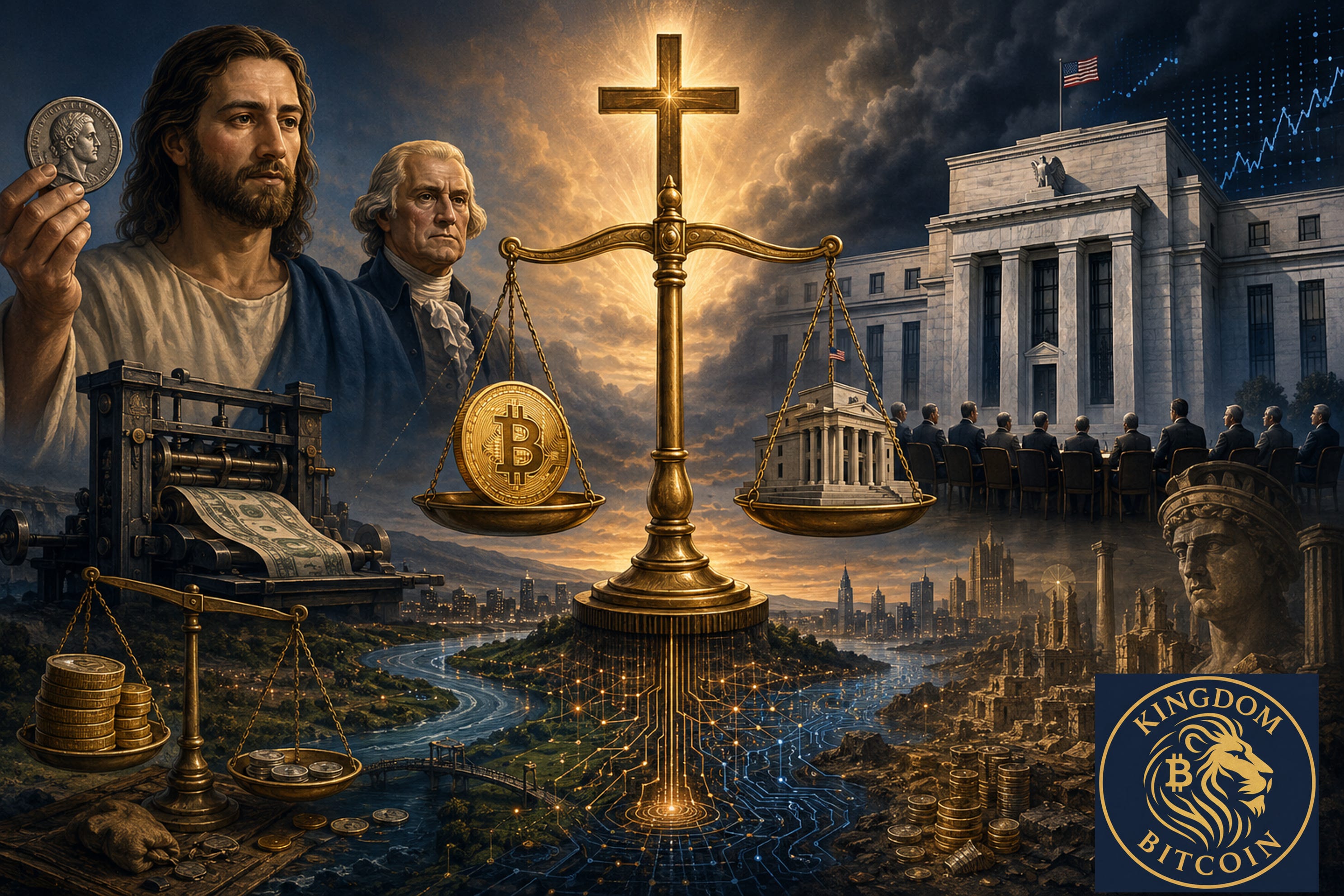
This concern explains why gold and silver occupied such an important place in the early American imagination. Precious metals were not viewed merely as commodities. They represented restraint. Gold could not be printed during a crisis. Silver could not be created by political decree. Their scarcity imposed limits on governments and citizens alike.
The Founders were not worshiping gold. They were respecting constraints. That distinction is crucial.
Throughout history, the healthiest societies have rarely emerged because leaders possessed unlimited power. They emerged because leaders operated within meaningful boundaries. The same principle applies to money. A monetary system that cannot be easily manipulated creates discipline. A monetary system without restraint eventually tempts people to solve short-term problems by creating larger long-term ones.
This is where bitcoin enters the conversation, not as a replacement for the Constitution, but as a continuation of a very old question. What if money itself could possess built-in limits? What if scarcity could be enforced by rules rather than promises? What if trust could rest less on institutions and more on transparent constraints that apply equally to everyone?
The Founders never imagined distributed computer networks or digital scarcity. Yet they would have immediately recognized the underlying principle. The question was never gold versus paper, or analog versus digital.
The question was always power. Who possesses it? What limits restrain it? And what happens when those limits disappear?
The Founders spent an entire summer wrestling with those questions because they understood something modern societies often forget. Freedom does not survive because people are good. Freedom survives because power remains constrained.
The same principle applies to money.
A currency ultimately reflects what a civilization believes about authority. Does it trust permanent rules or temporary promises? Does it rely upon discipline or discretion? Does it place limits on power or assume power will limit itself?
Those questions did not end in Philadelphia. They simply changed form.
The debates that once occurred around wooden tables now occur around central bank meetings, financial markets, and digital networks. The technologies have changed. Human nature has not.
The Founders did not fear bad kings. They feared what happened when good men were given kingly powers. And that raises another question.
If every nation eventually struggles with the temptation to concentrate monetary power, what happens when an entire civilization begins building itself upon debt?
Kingdom Principle 👑
Liberty requires limits on power.
God’s design consistently places boundaries around authority because He understands human nature better than we do. Whether in government, business, family, or money, freedom flourishes when power is constrained and accountability is present. Wise stewardship begins by recognizing that no person should possess authority without limits, including ourselves.
Prayer 🙏
Heavenly Father, thank You for the wisdom woven throughout Scripture and history. Help us learn from those who came before us and recognize the importance of humility, accountability, and restraint.
Guard our hearts from the temptation to seek power without limits. Teach us to steward faithfully the influence, resources, and responsibilities You have entrusted to us. May we use freedom wisely, honor truth courageously, and trust Your wisdom above our own.
In Jesus’ name, Amen. 🙏📖⚖️🇺🇸₿👑🕊️