

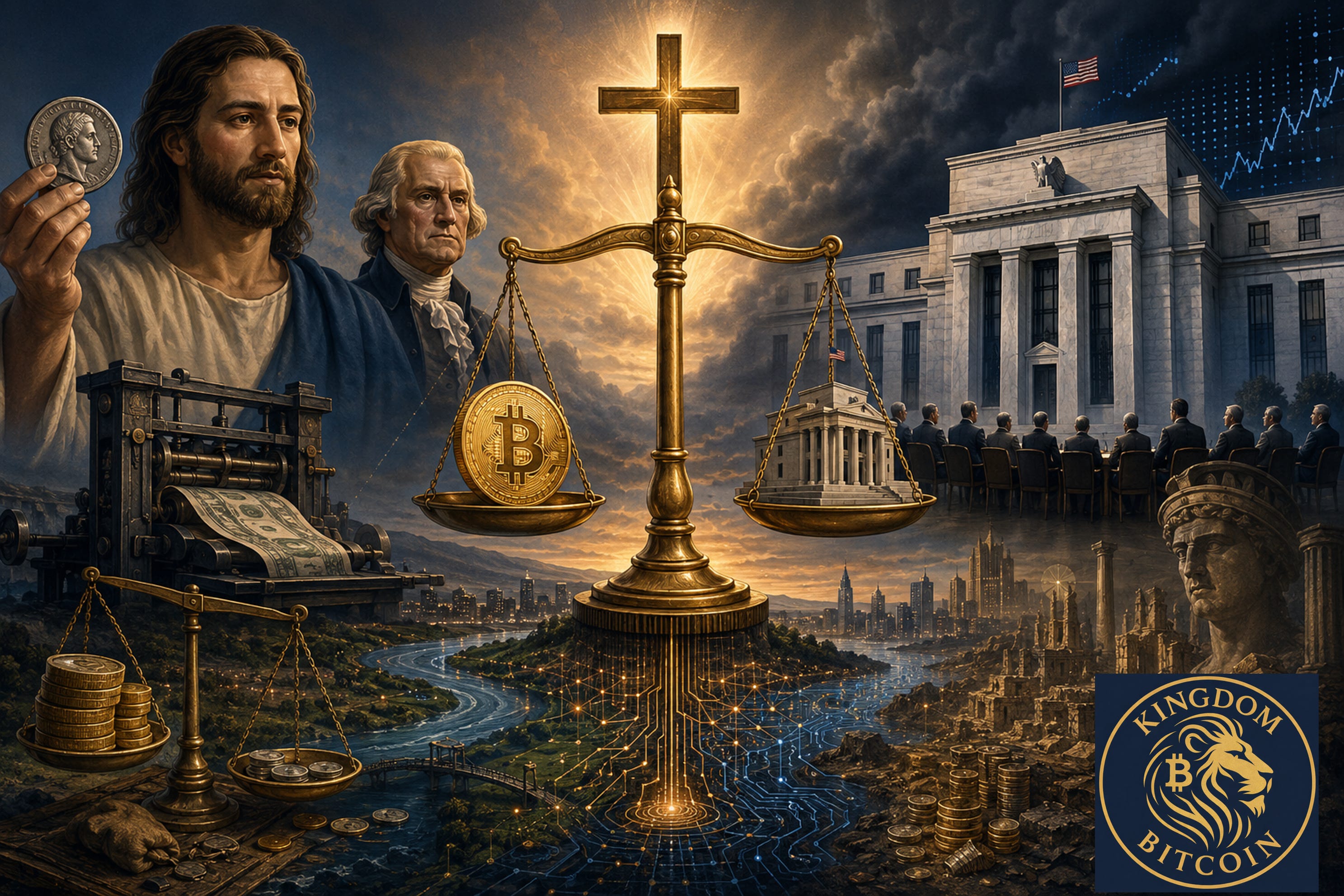
Every Empire Eventually Debases Its Currency
Nebuchadnezzar stood on the roof of his palace and admired what he had built.
Before him stretched Babylon, the greatest city in the ancient world. Massive walls surrounded it. Temples reached toward the heavens. Trade routes flowed through its gates. Wealth poured in from conquered nations. The city seemed invincible, a monument to human achievement and political power.
Scripture records his words with remarkable precision.
“Is not this great Babylon, which I have built by my mighty power and for the glory of my majesty?”
The statement was more than prideful boasting. It revealed a way of thinking that has appeared throughout history. Nebuchadnezzar had come to believe that the strength of Babylon originated from Babylon itself. The empire’s prosperity, military power, and economic dominance appeared permanent because he could no longer imagine a world in which Babylon was not at the center of it.
Every empire eventually arrives at that moment. The names change. The flags change. The technologies change. The assumption remains remarkably consistent. We are different. We are stronger. We have solved the problems that destroyed those who came before us.
History suggests otherwise.
One of the most fascinating patterns in civilization is how often great powers follow a similar trajectory. They rise through discipline, sacrifice, innovation, and courage. Wealth accumulates. Institutions mature. Trade expands. Confidence grows. Over time, however, confidence often transforms into something else. Restraint gives way to entitlement. Discipline yields to convenience. Hard choices are postponed. Difficult truths become politically expensive.
Eventually, leaders discover that creating money is easier than creating prosperity. That discovery has shaped centuries of history. Babylon understood it. Rome understood it. The governments of modern Europe understood it. The Weimar Republic understood it. Every empire eventually discovers that printing money is easier than telling the truth.
The Roman Empire offers one of history’s clearest examples. For generations, the denarius served as one of the most trusted currencies in the known world. It contained substantial silver content and facilitated trade across a vast territory. As Rome expanded, however, the financial demands of maintaining the empire increased. Armies needed funding. Bureaucracies grew. Public projects multiplied. The political cost of taxation remained unpopular.
The solution seemed obvious. Reduce the silver content of the coin while preserving its face value.
At first, the changes were small. Most citizens barely noticed. Over time, however, the process accelerated. Successive emperors continued diluting the currency. By the third century, the denarius contained only a fraction of the silver it once held. Prices rose. Trust declined. Economic instability spread throughout the empire.
The scale had changed. The sin had not.
Isaiah captured this dynamic centuries earlier when he wrote, “Your silver has become dross.” The prophet was describing moral corruption, but the metaphor worked precisely because monetary debasement was already familiar. Silver mixed with impurities still looked like silver. The deception worked because the change appeared gradual and manageable.
That is often how decline begins. Rarely through catastrophe. Usually through compromise.
The twentieth century offered its own version of the same story. Following World War I, Germany struggled beneath immense financial pressure. Political leaders faced impossible choices. Spending cuts were painful. Tax increases were unpopular. Borrowing became increasingly difficult.
The printing press offered another path.
The result became one of history’s most infamous monetary collapses. Savings evaporated. Middle-class wealth disappeared. Citizens carried wheelbarrows of cash to buy necessities. The numbers printed on banknotes grew larger while their purchasing power grew smaller. Currency multiplied. Value vanished.
The lesson remains uncomfortable because every generation assumes it would recognize the warning signs.
Most do not.
Ecclesiastes reminds us that there is “nothing new under the sun.” Human nature changes far less than technology. The methods evolve. The incentives remain familiar.
This brings us to a date that quietly reshaped the modern world.
August 15, 1971.
When President Nixon suspended the convertibility of dollars into gold, a chapter of monetary history closed. For centuries, money had maintained some connection to scarce physical assets. The connection was imperfect, often manipulated, and occasionally abandoned, but it imposed a form of discipline. The ruler could only move so far before reality pushed back.
After 1971, the relationship changed. Money increasingly became a matter of trust. Trust in governments. Trust in institutions. Trust in policymakers. Trust that future leaders would exercise restraint even when restraint became difficult.
To be fair, modern fiat systems have produced extraordinary benefits. Economic growth accelerated. Global trade expanded. Financial markets deepened. Millions escaped poverty around the world. Any honest assessment must acknowledge these achievements.
Yet the underlying question never disappeared. Can human beings be trusted indefinitely with a ruler that can be adjusted?
The answer matters because debt now sits at the center of the global economy. Governments borrow. Corporations borrow. Households borrow. Entire systems depend upon the assumption that tomorrow’s growth will support today’s obligations. The arrangement works remarkably well until growth slows, confidence weakens, or reality intrudes upon expectations.
Then the temptation returns. Create more currency. Extend more credit. Delay the reckoning. The challenge is not primarily economic. It is spiritual.
Revelation 18 describes Babylon not merely as a political power but as an economic system intoxicated by its own wealth and influence. Merchants prosper. Nations participate. Luxury expands. The entire structure appears permanent until suddenly it is not.
The warning is not that commerce is evil. The warning is that pride blinds civilizations to their own vulnerabilities.
Nebuchadnezzar learned this personally. Standing atop Babylon, he believed the empire’s strength originated from his own wisdom and power. God responded by reminding him of a truth every ruler eventually learns. Human authority is always temporary. Human institutions are always limited. Human systems are never ultimate.
The same principle applies to monetary systems. No currency lasts forever. No empire lasts forever. No institution remains immune from human nature.
This is where bitcoin enters the conversation, not as the hero of the story, but as a response to a recurring historical pattern. For thousands of years, societies have searched for a form of money capable of resisting the temptations that eventually overwhelm rulers and governments. Gold served that role for long periods. Bitcoin attempts to accomplish something similar through digital scarcity.
Whether it succeeds remains a question history will answer. What makes it remarkable is the problem it seeks to solve. The problem is not technology. The problem is human nature. That has always been the problem.
Babylon teaches us that prosperity can produce pride. Rome teaches us that power often erodes restraint. Weimar teaches us that monetary manipulation eventually reaches ordinary families. Modern history teaches us that debt has a way of accumulating faster than discipline.
The pattern repeats because the human heart repeats. Which is why the most important lesson from Babylon has nothing to do with Babylon.
It is the recognition that what is built upon pride eventually collapses beneath its own weight. And if every empire eventually struggles with that temptation, perhaps the next question is not about money at all. Perhaps it is about foundations.
What kind of system can survive the weaknesses of the people who build it?
Kingdom Principle 👑
What is built on pride eventually collapses under its own weight.
God opposes the proud but gives grace to the humble. Whether in our personal finances, businesses, governments, or nations, the moment we begin believing our success rests entirely on our own wisdom, we start down a dangerous path. Humility recognizes both blessing and limitation. Pride forgets both.
Prayer 🙏
Heavenly Father, protect us from the pride that has led so many individuals and nations astray. Remind us that every blessing comes from You and that no human achievement, institution, or financial system is beyond Your authority.
Give us humble hearts, wise judgment, and the courage to learn from history rather than repeat it. Help us build our lives on foundations of truth, stewardship, and dependence upon You. May our trust rest not in earthly kingdoms, but in Your eternal Kingdom that cannot be shaken.
In Jesus’ name, Amen. 🙏👑📖⚖️₿🕊️
Love you son. Love dad