

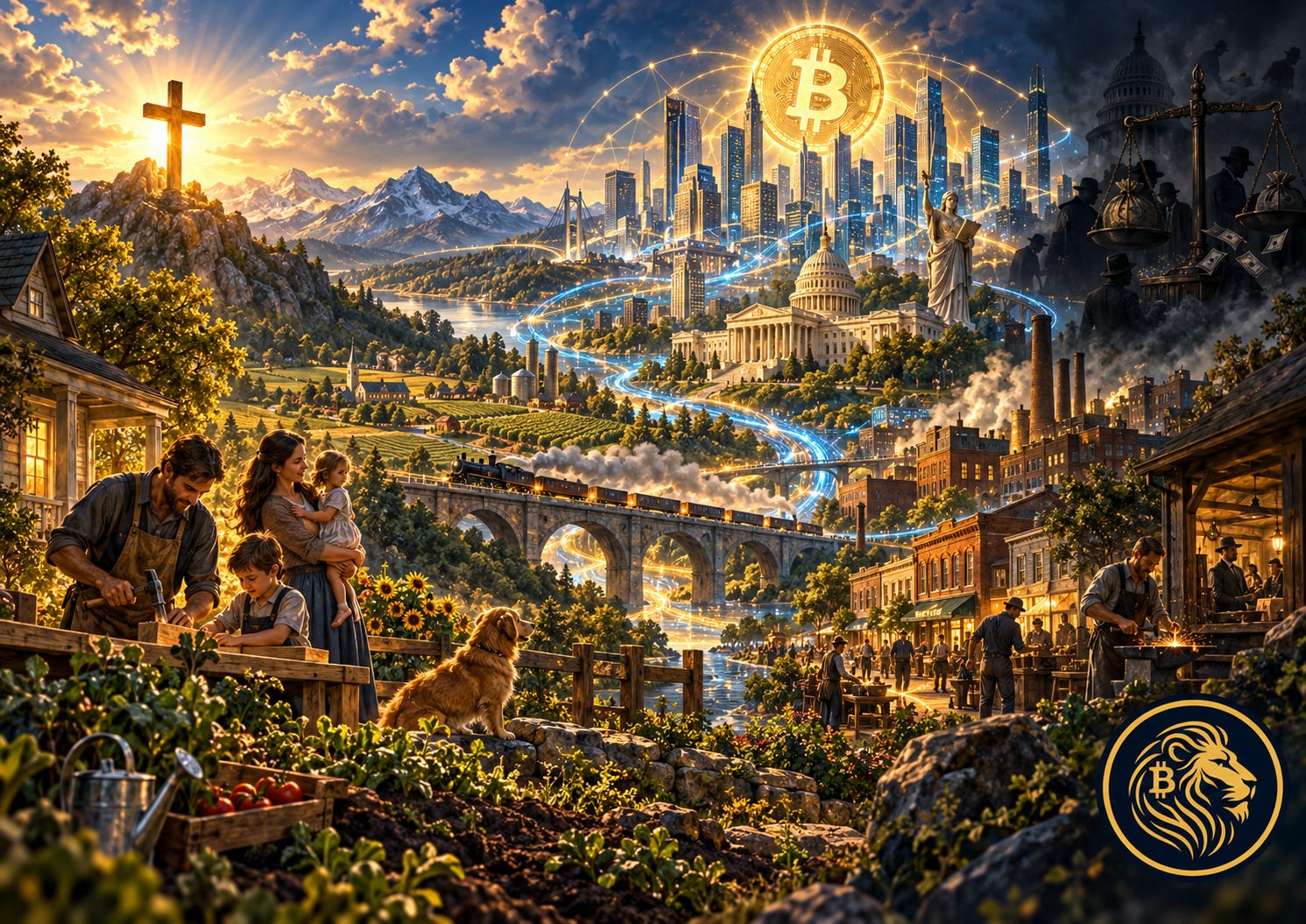
Venture Capital, Silicon Valley, Bitcoin, and the Future of American Enterprise
Lydia appears in Acts 16 with only a few lines of biography, but they tell us a great deal. She was a dealer in purple cloth, a merchant whose work connected her to trade, customers, and goods. When Paul came to Philippi, Scripture says the Lord opened her heart to respond to the message, and after she and her household were baptized, she opened her home as well. Commerce had given Lydia resources. Grace gave those resources a new purpose.
That is where I want to end this series on capitalism. Capitalism is healthiest when capital does not terminate on the owner. Savings become investment, investment gives a builder room to attempt something new, employees join the effort, and customers decide whether the product deserves to survive. At its best, capital is stored human effort being released into future possibility. The money is not the mission. It is fuel for the builder.
Venture capital makes that principle unusually visible because it finances uncertainty. A bank generally prefers predictable cash flows and assets it can understand. A venture investor may fund a company whose product is unfinished and market is uncertain. Many experiments fail. But capitalism needs people willing to fund the blank page because tomorrow’s company rarely arrives with ten years of audited financial statements.
America has repeatedly created room for that kind of builder. Benjamin Franklin began as a printer and became a publisher, inventor, and organizer of civic institutions, moving constantly between enterprise and usefulness. The American innovation story later moved through semiconductors, personal computing, the internet, and Silicon Valley. My own years at AWS gave me a front-row seat to another shift: cloud computing allowed builders to rent infrastructure as needed rather than buying equipment before the first customer arrived. AWS describes the model as replacing upfront capital infrastructure expense with variable cost that can scale with the business. That may sound like plumbing, but plumbing changes who gets to build.
Bitcoin arrived through another remarkable model. It is open-source, its design is public, and participation does not require permission from a company that owns the network. Anyone can inspect the rules, run software, build a wallet, operate a node, mine, or create a business around the protocol. That does not make every Bitcoin company wise or every entrepreneur righteous. It does mean the foundation itself offers an unusually open field on which builders can compete.
Artificial intelligence may lower the barriers again. Small teams can increasingly create products that once required far larger organizations. That could spread entrepreneurial power more broadly, or concentrate advantage around whoever controls compute, energy, models, and capital. Capitalism will have to wrestle honestly with both possibilities. “Technology will figure it out” is not a moral framework.
This lands at the household before it lands in Silicon Valley. The most important capitalist lesson we can teach our children may not be how to own stocks. It may be how to create something another person finds useful, serve a customer, save enough to try again, and survive being wrong without becoming ashamed of honest failure. Wealth is not created merely by watching numbers rise on a screen. Somewhere underneath durable wealth, someone usually built something, solved something, served someone, or took a risk others were unwilling to take.
Jesus said, “From everyone who has been given much, much will be demanded.” Lydia seems to have understood that instinctively. Her business was not condemned when she encountered Christ. Her heart was reordered, and what she possessed became useful to the people God placed in front of her. The Holy Spirit does not call us away from productive work. He calls us to place the work, the capital, and the ambition beneath God.
That is the future of capitalism worth defending. Not capitalism as consumption without limits, finance without production, or wealth without obligation. I mean capitalism that gives the next builder a chance, allows honest failure, rewards useful creation, and turns prosperity outward in service. Bitcoin can widen the architecture of ownership. AI can widen the architecture of capability. But character will still determine whether wider possibility becomes human flourishing.
Capital should be fuel for builders, not merely chips on a financial table. The greatest question is not how much capital we can accumulate. It is what God expects us to build with what He entrusted to us.
Kingdom Principle 👑
Capital finds its highest purpose when it equips people to build, serve, create, and leave more possibility for those who come after them.
Capitalism at its healthiest converts savings into productive possibility. It gives someone with an idea the opportunity to attempt what does not yet exist, gives customers the freedom to decide whether that creation deserves to endure, and gives successful builders the ability to invest again. But capital must remain beneath character. Otherwise the fuel becomes the destination.
For Christians, the question is never merely whether wealth multiplied. Jesus asks what we did with what was entrusted to us. Economic freedom becomes Kingdom stewardship when prosperity increases our capacity to serve, give, build, employ, teach, and create opportunity for people beyond ourselves.
Prayer 🙏
Heavenly Father, thank You for builders, entrepreneurs, investors, workers, inventors, and all those willing to take risks to create something useful for others. Give America the courage to remain a place where the next builder can begin, where honest failure is not permanent defeat, and where capital continues flowing toward productive ideas rather than merely financial engineering.
Holy Spirit, govern our ambitions and teach us to recognize that every resource ultimately comes from You. Keep Jesus Christ above our companies, investments, technologies, and achievements. May the capital entrusted to us become fuel for service, opportunity, generosity, innovation, and human flourishing for generations still to come. In Jesus’ name, Amen. 🙏📖🇺🇸🏗️💡💼☁️₿🤖🕊️👑