

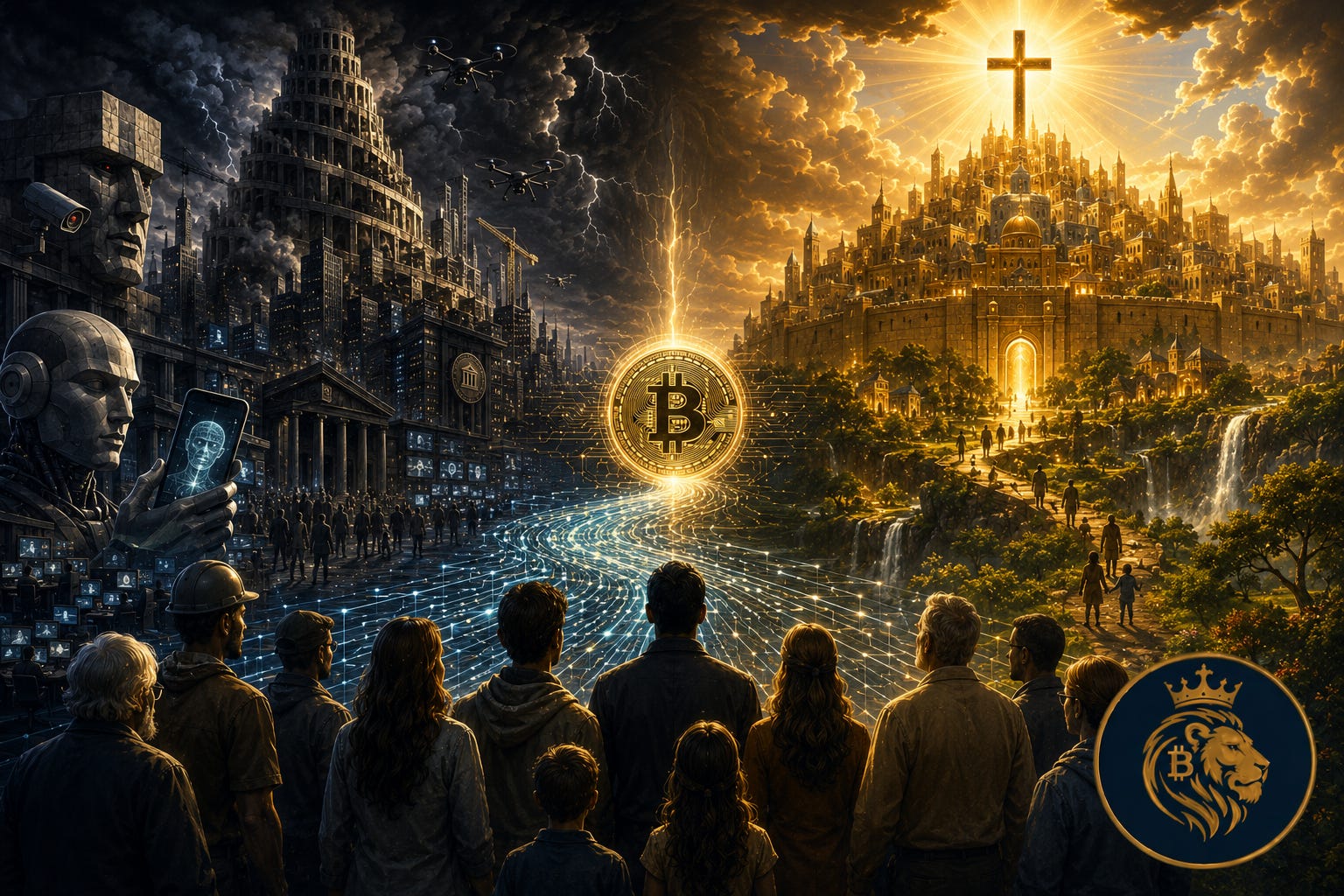
Every generation inherits a construction site.
Some generations build roads. Others build empires. Some raise cathedrals that inspire worship for centuries. Others erect monuments to themselves that eventually become ruins buried beneath the sands of history. The tools change, the technologies evolve, and the language of progress adapts to each age, but the fundamental question remains remarkably consistent: What are we building, and for whose glory?
That question feels especially relevant today.
Artificial intelligence is advancing at a breathtaking pace. Governments around the world are exploring digital currencies. Data has become one of the most valuable assets on earth. Financial systems are being rewritten. The relationship between technology, money, and power is changing faster than most people can comprehend. We are witnessing the birth of a new digital civilization, yet very few are asking whether the foundations being laid beneath it are strong enough to support human flourishing.
The conversation is often framed as a debate about technology. Will artificial intelligence save humanity or threaten it? Will digital currencies increase efficiency or reduce freedom? Will technological innovation create abundance or deepen inequality?
Those are important questions, but they are not the deepest questions. The real battle before us is not AI versus humanity. The real battle is Babel versus Jerusalem.
To understand why, we must begin before Babel. We must return to Eden.
The first temptation in Scripture was not about money, politics, or technology. It was about autonomy. The serpent did not tempt Adam and Eve with material wealth. He tempted them with power. “You will be like God” remains one of the most consequential lies ever spoken. Humanity was invited to believe that wisdom could be separated from obedience, that knowledge could be pursued apart from relationship with God, and that creation could flourish under human authority alone.
Every major rebellion in history traces its roots back to that same temptation. Babel was simply Eden institutionalized.
Genesis 11 describes humanity gathering together with one language, one vision, and one collective ambition. They declared, “Come, let us build ourselves a city and a tower with its top in the heavens, and let us make a name for ourselves.”
Notice what is absent from their declaration. There is no dependence upon God. No acknowledgment of stewardship. No pursuit of worship. No desire to glorify the Creator. The problem was never the tower itself. The issue was not architecture. The issue was authority.
Babel represented humanity’s attempt to centralize power, language, influence, and identity apart from God. It was an effort to secure unity without submission, greatness without humility, and permanence without covenant. The tower became the visible manifestation of a deeper spiritual reality. Human beings were attempting to build a future in which God was no longer necessary.
That ancient temptation has not disappeared. It has simply become digital.
The modern world is increasingly organized around systems that promise greater control, greater efficiency, greater optimization, and greater certainty. Artificial intelligence promises unprecedented analytical power. Governments are exploring digital currencies capable of fundamentally altering the relationship between citizens and money. Technology companies collect and monetize extraordinary amounts of information about human behavior. Financial institutions increasingly rely on algorithms to make decisions once entrusted to people.
None of these developments are inherently evil. Technology itself is not the enemy. Human creativity is a gift from God. Innovation can alleviate suffering, expand opportunity, and improve lives. The danger emerges when technological power becomes detached from moral responsibility and when human beings begin placing their faith in systems rather than in the One who created them.
The greatest threat of artificial intelligence is not that machines become human. It is that humans begin acting like machines.
Machines optimize. Machines calculate. Machines process information at extraordinary speed. Human beings were created for something entirely different. We were created in the image of God. We were designed for relationship, worship, stewardship, creativity, sacrifice, and love. We possess the ability to discern right from wrong because we were created with a conscience. We can forgive because we have experienced grace. We can worship because we were made for communion with our Creator.
No algorithm can replicate those realities.
The more a civilization forgets that distinction, the more vulnerable it becomes to building a modern version of Babel.
This is one reason I find the conversation surrounding bitcoin so fascinating. Most discussions about bitcoin begin and end with price, politics, or speculation. Supporters often frame it as a revolutionary financial technology. Critics frequently dismiss it as a volatile digital asset. Both perspectives miss something deeper.
Bitcoin is not most interesting because of what it might be worth. Bitcoin is most interesting because of what it reveals.
Initially, I thought bitcoin was primarily a technology problem. The longer I have studied Scripture, history, economics, and human nature, the more I have come to believe that bitcoin is forcing a much older conversation. It is forcing us to ask whether truth still matters in a world increasingly organized around power.
At its core, Babel sought to centralize trust. Bitcoin distributes trust.
Babel concentrated authority in the hands of a few. Bitcoin operates through transparent rules that apply equally to everyone. Babel relied upon rulers. Bitcoin relies upon verification. This does not make bitcoin perfect, nor does it elevate bitcoin to something sacred. Only Christ occupies that position. Yet Bitcoin introduces a principle that aligns remarkably well with biblical wisdom: power functions best when it is restrained by rules rather than concentrated through discretion.
This matters because Scripture consistently presents limits as gifts rather than obstacles.
The Sabbath established limits on work. The Ten Commandments established limits on behavior. Even the Garden of Eden contained boundaries. Modern culture often views limits as restrictions on freedom, yet God presents them as safeguards for flourishing. The Creator understands what humanity repeatedly forgets: unlimited power eventually corrupts those who possess it.
Whether that power is political, financial, technological, or personal, it must remain accountable to a higher authority.
This is one of the reasons bitcoin is so offensive to the modern monetary imagination. It refuses the logic of unlimited expansion. It imposes a boundary. It reminds us that not everything should be infinitely scalable. In an age obsessed with more, bitcoin quietly introduces the concept of enough.
That is not merely a financial observation.
It is a theological one.
Psalm 127:1 reminds us, “Unless the Lord builds the house, those who build it labor in vain.”
The builders of Babel were intelligent. They were innovative. They were ambitious. They worked hard. Yet they were ultimately building something disconnected from God’s purposes. The warning of Babel is not against construction. It is against constructing a future that no longer acknowledges its dependence upon God.
The remarkable truth is that Scripture does not end with Babel.
It ends with a city.
In Revelation 21, John sees the New Jerusalem descending from heaven. Unlike Babel, humanity does not build this city through its own striving. It is received as a gift. Unlike Babel, it is not designed for self-glorification. It exists for communion with God. One city emerges from pride. The other emerges from grace. One seeks to elevate man. The other glorifies God.
Every generation inherits a construction site.
Our generation’s construction site happens to be digital.
We are building artificial intelligence systems. We are building new monetary networks. We are building digital economies and global communication platforms. Long after today’s technologies evolve and today’s headlines disappear, one question will remain.
Did we build a tower to ourselves? Or did we help prepare the way for the City of God?
The tools may be new. The choice is ancient.
Kingdom Principles 👑
1. God Opposes Pride
The story of Babel reminds us that the greatest threat to civilization is not technological advancement but human arrogance. Progress detached from humility eventually becomes destructive.
2. God Honors Stewardship
Technology, money, and influence are tools entrusted to us by God. They are blessings when stewarded wisely and become dangerous when they become substitutes for Him.
3. God Values Limits
Boundaries are not evidence of God’s restriction but His protection. The same God who created the Sabbath also designed creation with order, purpose, and restraint.
4. Freedom Is Not Rebellion
Biblical freedom is not the absence of authority. It is living under the right authority. True freedom flourishes when God remains King.
5. Every Generation Builds Something
The question is never whether we are building. The question is what we are building and who ultimately receives the glory.
Prayer 🙏
Heavenly Father,
In an age of extraordinary technological power, grant us extraordinary wisdom. Protect us from the pride that built Babel and cultivate within us the humility that builds Your Kingdom. Help us discern the difference between innovation and idolatry, between stewardship and control, between freedom and rebellion.
Teach us to see technology, money, and influence through Your eyes. May we never place our trust in systems, institutions, governments, algorithms, or wealth more than we trust in You. Give us courage to stand for truth when the world pursues convenience, and conviction to pursue righteousness when power seems more attractive.
Lord Jesus, remind us that every city built by man eventually fades, but Your Kingdom endures forever. May the work of our hands point people to the glory of God rather than the glory of ourselves. Through the power of the Holy Spirit, help us become faithful builders in this generation, preparing the way not for another tower of Babel, but for the coming of the New Jerusalem.
In Jesus’ mighty name,
Amen. 🙏 ✝️ 👑 🕊️ ₿ 📖 🌎 ⚡️