

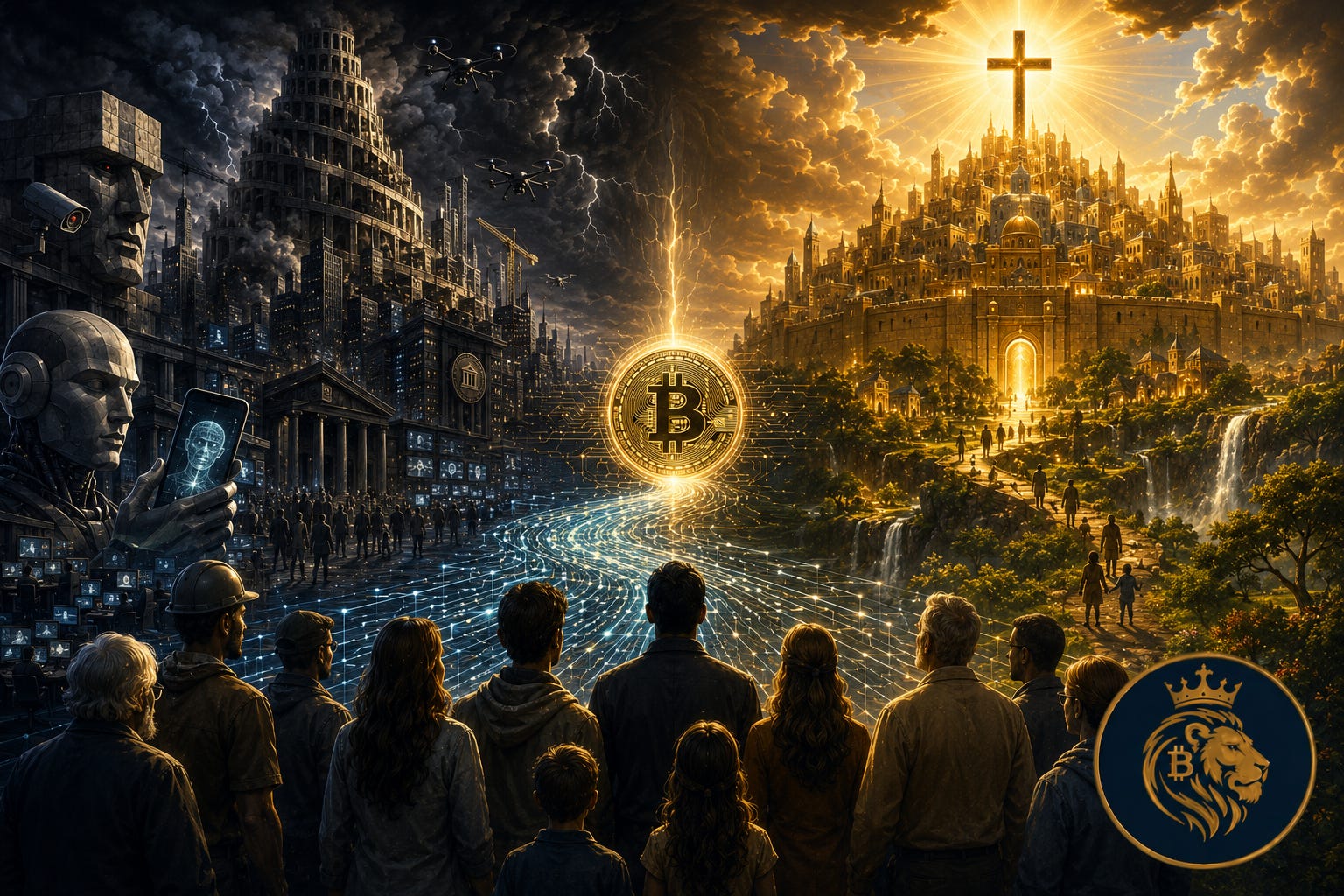
Every generation eventually discovers that its greatest challenges are not technological.
They are spiritual.
The technologies change. The institutions evolve. The tools become more sophisticated. New industries emerge while old ones disappear. Entire civilizations rise, flourish, and fade into history. Yet beneath the visible movements of history, something remarkably consistent remains. Human beings continue asking the same questions their ancestors asked thousands of years ago. Who will we trust? What will we worship? How should power be used? What does it mean to live a good life? What kind of world are we building for those who come after us?
The modern world often assumes that history is primarily a story of progress. We move from primitive to advanced, from simple to sophisticated, from ignorance to knowledge. There is truth in that observation. Technology has improved. Scientific understanding has expanded. Communication, transportation, and medicine have advanced in ways previous generations could scarcely imagine. Yet history also reveals another reality. Human beings may become more technologically capable without becoming more morally mature. Knowledge can increase while wisdom declines. Power can expand while character erodes. The tools become stronger while the hands holding them remain unchanged.
This is why the central issue of our age is not artificial intelligence, bitcoin, digital currencies, governments, corporations, or even the economy itself. Those are important subjects, but they are not the deepest subjects. They are manifestations of a more fundamental reality. The real battle has always been a battle over worship.
Augustine understood this better than perhaps anyone outside the biblical authors themselves. Writing as the Roman Empire was beginning to crumble, he described human history through the lens of two cities. These cities were not defined by geography or political boundaries. They were not identified by flags, languages, or military strength. They were defined by love. One city was built by the love of self, even to the contempt of God. The other was built by the love of God, even to the surrender of self. Every institution, every culture, every economy, every government, and every civilization ultimately aligns itself with one of these two loves.
When viewed through this framework, the entire biblical narrative takes on a remarkable coherence. Eden was not merely a garden. It was a place where humanity lived in proper relationship with God. Babel was not merely a tower. It was humanity’s attempt to build significance apart from God. Babylon was not merely an empire. It became a symbol of human civilization organized around power, wealth, control, and self-glorification. Jerusalem was never merely a city. It represented God’s covenantal relationship with His people and His desire to dwell among them.
The same tension continues into the final pages of Scripture. The Book of Revelation does not conclude with economic forecasts, political reforms, or technological solutions. It concludes with a choice between Babylon and the New Jerusalem. One city is built upon pride. The other is received through grace. One accumulates power. The other reflects worship. One seeks salvation through human effort. The other receives redemption as a gift.
This distinction matters because modern civilization increasingly resembles a digital version of Babylon.
The language is different, but the spirit is familiar. We are told that enough technology can solve our deepest problems. We are told that greater connectivity will create greater unity. We are told that more information will produce greater wisdom. We are told that enough innovation can eventually overcome every human limitation. In subtle ways, society has begun placing its faith in systems, algorithms, institutions, and technologies to provide what previous generations sought from God.
The irony is that none of these things are inherently evil. Technology itself is not the problem. Money is not the problem. Innovation is not the problem. Throughout Scripture, human creativity is presented as a gift from God. The issue arises when gifts become substitutes for the Giver. The problem emerges when tools become objects of trust. What begins as stewardship quietly becomes idolatry.
This is why Christians must approach both enthusiasm and fear with caution. Some view artificial intelligence as humanity’s salvation. Others view it as humanity’s destruction. Both perspectives assign too much power to technology. The same mistake is often made with money. Some people look to governments to solve every economic challenge. Others look to markets. Still others place their hope in Bitcoin, gold, or financial innovation. Yet none of these things possess the ability to heal the human heart.
Bitcoin has occupied an important place throughout this series, but bitcoin is not the hero of the story. Bitcoin may help preserve value. Only Jesus restores identity. Bitcoin may help expose weaknesses in monetary systems. Only Jesus reveals ultimate truth. Bitcoin may protect savings from dilution. Only Jesus saves souls. Bitcoin may encourage long-term thinking. Only Jesus offers eternal perspective.
This distinction is essential because every generation is tempted to place messianic expectations upon earthly solutions. Throughout history people have looked to kings, armies, governments, revolutions, economic systems, and technologies to provide what only God can provide. Every generation eventually discovers the same lesson. No system can redeem humanity because humanity itself is the source of the problem.
The Gospel begins where every other solution fails.
The Christian worldview does not teach that our greatest need is more information. It teaches that our greatest need is transformation. The fundamental issue is not that humanity lacks intelligence. It is that humanity lacks righteousness. We do not merely need better technology. We need redemption. We do not merely need more efficient systems. We need reconciled hearts. We do not merely need innovation. We need Christ.
This truth places a tremendous responsibility upon the Church.
The world does not need Christians who simply condemn technology, nor does it need Christians who blindly celebrate every innovation. The world needs believers capable of bringing biblical wisdom into rapidly changing environments. It needs men and women who understand that technology must remain under covenant, money must remain under stewardship, power must remain accountable, and truth must remain anchored in God’s character. The Church is uniquely positioned to offer that perspective because Christianity possesses something modern culture increasingly lacks: an understanding of both human dignity and human fallenness.
Human beings are capable of extraordinary creativity because they bear the image of God. Human beings are also capable of extraordinary corruption because sin remains a reality. Forget either truth and civilization becomes distorted. Forget both and Babylon inevitably follows.
Perhaps this is why the conversation surrounding Bitcoin has always felt larger than Bitcoin itself. At its core, Bitcoin forces a discussion about trust, authority, stewardship, truth, and human flourishing. Those are not merely economic questions. They are theological questions. They are questions that ultimately lead us back to worship.
What we worship eventually shapes what we build. A culture that worships comfort will build systems designed around convenience. A culture that worships power will build systems designed around control. A culture that worships wealth will build systems designed around accumulation. A culture that worships God will build systems that honor truth, stewardship, responsibility, justice, and human dignity.
Civilization is always downstream from worship.
That observation may be the most important lesson of this entire series.
The future will not ultimately belong to artificial intelligence, financial markets, governments, corporations, or even technological innovation. Every one of those realities will continue changing. New technologies will emerge. Existing institutions will evolve. Entire industries will be disrupted. Yet long after today’s headlines have disappeared, one truth will remain unchanged.
Jesus Christ is King. His Kingdom continues advancing. His truth continues liberating. His Gospel continues transforming hearts. His Church continues carrying hope into a broken world.
The question before Christians is not whether bitcoin succeeds. The question is whether the Church will help shape the civilization that emerges around it.
That is the choice facing our generation. Not merely how we use technology. Not merely how we think about money. Not merely how we steward innovation. The deeper question is whether we will build another Babylon organized around power, self-sufficiency, and human glory, or whether we will help prepare the way for a civilization shaped by truth, stewardship, worship, and the Lordship of Jesus Christ.
Every generation inherits a construction site. Every generation lays foundations that future generations will inherit. Every generation chooses which city it is helping build.
May we be found building Jerusalem.
Kingdom Principles 👑
1. Christ Is King
Every economic system, political structure, technological innovation, and cultural movement ultimately exists under the authority of Jesus Christ.
2. Stewardship Is Worship
How we use money, technology, time, influence, and opportunity reveals what we truly believe about God’s ownership and sovereignty.
3. Technology Must Remain Under Covenant
Innovation becomes dangerous when detached from truth, wisdom, and responsibility. Technology is a tool, not a master.
4. Money Is a Servant, Not a Savior
Bitcoin, gold, fiat currencies, and financial systems all serve important functions. None can provide redemption, identity, purpose, or eternal hope.
5. We Are Builders of Jerusalem
Christians are called to help build communities, institutions, families, businesses, and churches that reflect the values of God’s Kingdom rather than the spirit of Babylon.
Prayer 🙏
Heavenly Father,
Thank You for guiding us through every season of history and every age of human innovation. In a world increasingly captivated by power, technology, wealth, and influence, help us keep our eyes fixed on Your Kingdom. Guard our hearts from the temptation to place our trust in systems, institutions, markets, governments, or technologies more than we trust in You.
Lord Jesus, remind us that You alone are King. Teach us to steward every blessing You have entrusted to us with humility, wisdom, and faithfulness. May we never confuse tools for treasures or temporary solutions for eternal truth. Help us use money, technology, and opportunity in ways that honor You and serve others.
Holy Spirit, grant us discernment in the days ahead. Give us courage to speak truth when culture embraces confusion. Give us wisdom to navigate change without compromising conviction. Give us faith to build for future generations while remaining anchored in Your promises.
May revival begin in our homes, our churches, our businesses, and our communities. May we become faithful builders of the New Jerusalem’s values while we await the return of our King. Let every decision we make point people toward Jesus Christ, the only source of lasting freedom, enduring truth, and eternal life.
In Jesus’ mighty and sovereign name, Amen. 🙏 ✝️ 👑 🕊️ 📖 ₿ 🌎 ⛪ ❤️ ✨
One word … Selah! This whole message is beautiful. It’s up to the church, not the institutional church, the church that embraces and disciples nations… the whole of nations, every facet of the nation’s culture - raising up leaders in government. business, entertainment, media, education, financial institutions… nations under God