

Long before there was a Declaration of Independence, there was a declaration of dependence.
The floor beneath Moses’ feet had been polished by generations of servants. Incense hung in the air. Gold flashed from the wrists of men who had never made bricks, harvested straw, or buried a child under Pharaoh’s decree. Everything in the room had been arranged to communicate one message: Egypt owned what Egypt could command. Pharaoh’s authority stretched across fields, households, temples, armies, storehouses, and generations of enslaved people whose labor had become part of Egypt’s wealth. Every visible source of power suggested that the question of ownership had already been settled.
Moses stood before him with a sentence that would trouble every empire after Egypt: “Let my people go.” The words were spoken by a man, but the claim belonged to God. The Exodus is certainly a story of liberation, but beneath the plagues and miracles sits a deeper question: who owns what God has created? Pharaoh believed the Hebrews belonged to him. Their labor served his economy, their children strengthened his future, and their suffering was simply the cost of his empire. God disagreed, and every plague became a judgment against the illusion that earthly power can possess what Heaven has already claimed.
Every true freedom story begins when false ownership is exposed. Human beings belong to God before they can ever be claimed by the systems that surround them. Tyranny begins when men forget that. Freedom begins when they remember it. The American story flows from that same ancient river. The men who gathered in Philadelphia in the summer of 1776 did not invent this truth. They inherited it, argued from it, and placed it at the center of a document that would become one of the most consequential pieces of parchment in human history.
Philadelphia was nearly unbearable that summer. Heat pressed against the brick buildings and settled into the streets until the whole city seemed to sweat. Horse manure baked beneath the sun. Flies moved through open windows. Inside the Pennsylvania State House, wool coats clung to tired bodies as delegates debated not only the wording of a document, but the fate of their lives. Outside, ordinary commerce continued with almost insulting normalcy. Wagons creaked past doorways, merchants tended their goods, and children moved through streets unaware that history was being written in rooms close enough for their laughter to reach.
The men inside were not statues yet. Thomas Jefferson was thirty-three years old, brilliant and restless, with the inward fire of a young man who believed words could reorder the world. John Adams was older, harder, and more relentless, a man of conviction who had little patience for hesitation when principle was at stake. Benjamin Franklin, at seventy, carried a different kind of authority. He had already lived enough life for several men, and age had given him perspective younger men could not manufacture. Jefferson brought language. Adams brought force. Franklin brought memory.
That tension mattered. Jefferson could write beauty, but beauty alone would not win independence. Adams could burn with conviction, but conviction alone would not sustain a people through war. Franklin understood that both beauty and conviction would eventually be judged by Heaven. The room needed all three. It needed the young man who could give the proposition language, the advocate who could drive it toward action, and the old man who knew that human brilliance must answer to something higher than itself.
Between them sat the parchment. It had no power in itself. It was prepared skin, ink, and space. Yet every civilization eventually produces some testimony of what it believes deeply enough to write down and risk defending. For America, that parchment would announce more than separation from Britain. It would make a claim about reality itself. The colonies were not merely arguing that King George had governed poorly. They were arguing that there were limits even kings could not cross because the rights of man did not originate with kings at all.
That is what makes the Declaration extraordinary. The grievances matter, but they are not where the document begins. The taxes, soldiers, trade restrictions, and abuses of power all drove the colonies toward independence, but Jefferson reached beneath them to the source of authority itself. He appealed to “the Laws of Nature and of Nature’s God.” He declared that all men “are endowed by their Creator with certain unalienable Rights.” Near the end, the signers appealed to “the Supreme Judge of the world,” and in the final sentence they expressed “a firm reliance on the protection of divine Providence.” These phrases were not patriotic ornament. They were the foundation beneath the whole argument.
The Founders were not asking government to be generous enough to grant rights. They were insisting that rights already existed because God had given them. Jefferson understood that any authority capable of granting liberty would eventually claim the authority to define it. A right that originates in Parliament remains vulnerable to Parliament. A liberty dependent upon royal permission can disappear when the Crown’s patience runs out. The genius of the Declaration was its insistence that human dignity stands beyond the reach of every earthly institution. Genesis 1:27 became political language: human beings possess dignity because they bear the image of God.
The Founders did not fully live up to the truth they declared, and no honest telling of American history should pretend otherwise. Slavery was a grievous violation of the very principle the Declaration announced. Yet the genius of the American Founding was that it placed a truth at the center of the nation strong enough to judge every generation, including the one that wrote it. The Declaration gave abolitionists the moral language. The Constitution gave future Americans a structure capable of correction. The Bill of Rights protected the speech and conscience of those who would insist that America become more faithful to her own creed. The sin was real. The correction was possible because the founding truth was stronger than the founding failure.
George Washington understood the hand of God through experience more than theory. He had watched an outmatched army survive when ordinary calculation suggested collapse. At Valley Forge, he saw men suffer through hunger, cold, disease, and exhaustion while the cause of independence appeared fragile enough to disappear. Bare feet left bloody traces in snow. Supplies failed. Morale thinned. Yet the army endured. Washington’s later language about God’s unseen hand was not ceremonial polish added to public speeches. When he said in his First Inaugural that no people were more bound to acknowledge the invisible hand that conducts the affairs of men than the people of the United States, he was speaking as a witness. He had seen too much to call survival coincidence.
The war did not end with America merely feeling independent. It ended with the world recognizing it. In 1783, the Treaty of Paris formally closed the struggle and acknowledged the United States as free, sovereign, and independent. Its opening words were not sterile or secular. The treaty began “In the Name of the most Holy and undivided Trinity” and spoke of Divine Providence disposing hearts toward peace. That matters. The Declaration had appealed to God at the birth of the nation. The treaty that ended the war still spoke as though history unfolded beneath Heaven. America’s founding generation did not imagine freedom as a purely secular achievement. They understood that independence, peace, and posterity all rested under the authority of God.
Philadelphia would give America her founding words. The city that would one day bear Washington’s name would carry the burden of whether those words were honored. That arc matters because a nation is not judged only by what it declares at birth. It is judged by what it preserves in maturity. The Declaration named the source of freedom. The future capital would become a standing test of whether power could remain servant rather than master.
Franklin’s witness came through age and long acquaintance with human limits. He was old enough to know that empires rise with confidence and fall with surprise. He had watched human intelligence solve real problems and create new ones. He knew brilliance could become its own temptation if it forgot humility. Years after the Declaration, during another national crisis in another room, Franklin would remind younger men that God governs in the affairs of men and that unless the Lord builds the house, those who build it labor in vain. But even in 1776, that conviction already marked him. The old man knew America would need more than eloquence and courage. It would need the Lord’s aid.
John Adams saw the matter through moral formation. For Adams, liberty could not survive among people unwilling to govern themselves. A free society required citizens shaped by conscience, duty, and restraint. Political liberty without moral character would eventually collapse into appetite, and appetite would eventually invite control. Adams understood that the outer architecture of freedom depended upon an inner architecture of virtue. A people who reject every higher restraint will eventually find themselves restrained by something lower.
At 250, the Declaration still speaks because it was never merely announcing independence. It was naming the source of freedom. It tells us where rights come from, why government must be limited, and why human dignity cannot be surrendered to any earthly power. The words endured because the truth beneath them was stronger than the men who wrote them. The parchment became an inheritance because the claim was larger than a generation.
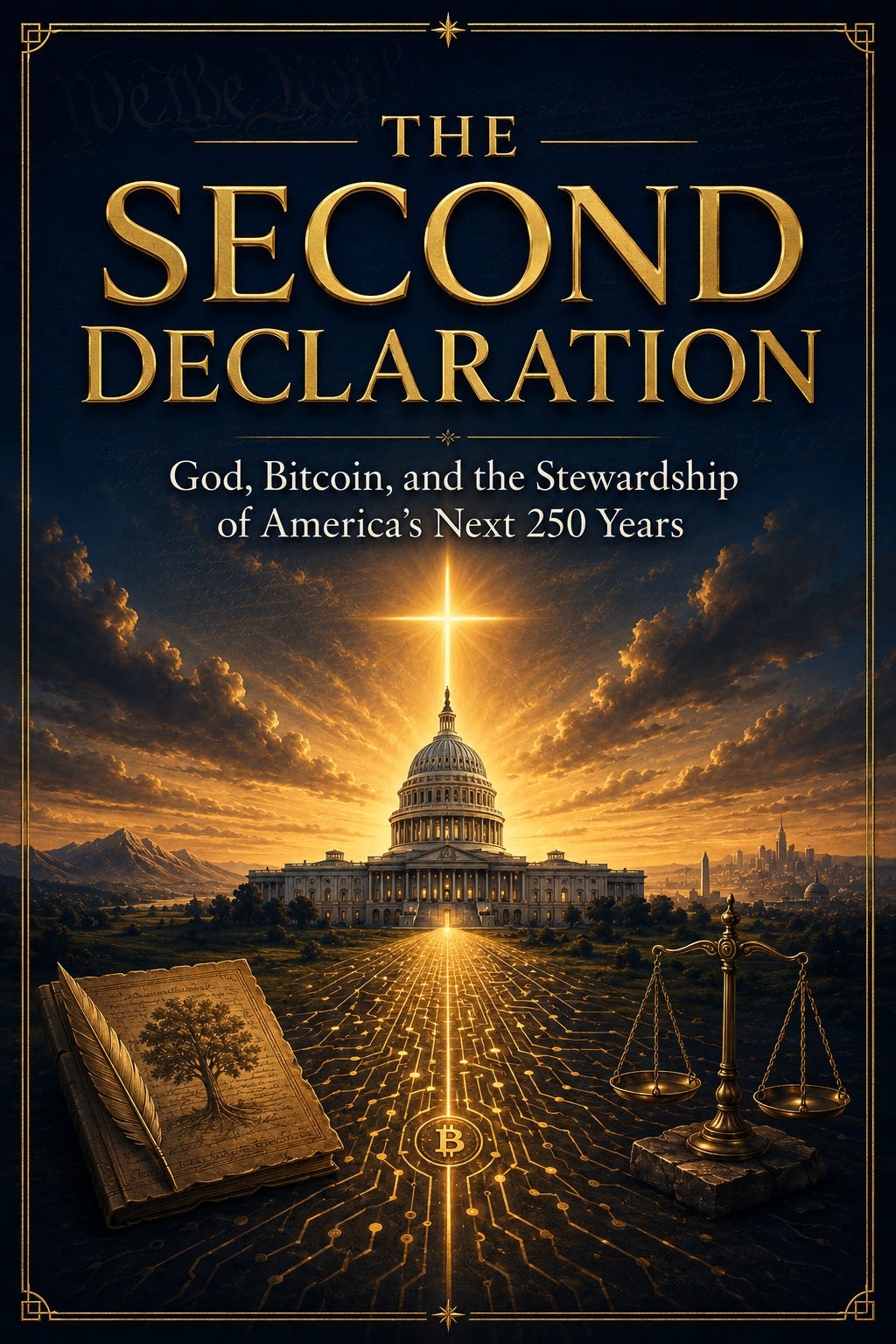
The scale enters quietly here, as all true measures do. Proverbs says honest balances belong to the Lord because God cares about measurement. A false measure does more than cheat a transaction; it lies about reality. If rights require a true source, justice requires a true measure. America would eventually forget how much depends on that.
More than two centuries after Jefferson wrote, another short document appeared in a very different kind of crisis. On October 31, 2008, an unknown figure using the name Satoshi Nakamoto released a nine-page whitepaper titled Bitcoin: A Peer-to-Peer Electronic Cash System. It did not arrive from a hall of statesmen, and it carried no signatures of famous men. It was not a Declaration of Independence and should never be treated as one. Jefferson had written that rights did not wait upon a king. More than two centuries later, Satoshi would write as though money need not wait upon a central authority. The documents are not equal. They are not even the same kind of thing. But they rhyme because both were born from the suspicion that freedom cannot rest entirely in human permission.
The final symbol is not introduced by an object, but by a wound in the heart: inheritance. The men who signed the Declaration never met us, yet they sacrificed for us anyway. The question is whether we will do the same for those we will never meet.
They never saw our homes, held our children, or knew the names of the sons, daughters, and grandchildren who would one day inherit the country they risked everything to create. Still, they pledged lives, fortunes, and sacred honor so that people beyond their imagination might live free. They planted trees beneath whose shade they would never sit. They built a house they would never fully inhabit. They placed a parchment into history and trusted future generations to guard what was written there.
We are those future generations. We inherited a republic we did not found, a Constitution we did not draft, a Bill of Rights we did not force into existence, and liberties secured by sacrifices we did not make. The question facing America at 250 is not whether the Founders were perfect. They were not. The question is whether we have been faithful with what they entrusted to us.
They wrote with parchment and ink. We will write with systems, households, money, and truth. The parchment survives only if the people remember what it says. The scale remains honest only if truth remains valued. The inheritance grows only if stewardship becomes stronger than consumption. And the next threat to liberty would not arrive wearing a crown. It would arrive carrying power of a different kind. The men who saw it coming called themselves Anti-Federalists. One of them called himself Brutus.
Kingdom Principle 👑
Freedom begins when God, not government, is the source of rights.
The Founders understood that rights secured by governments can eventually be altered by governments. Rights rooted in God stand above every earthly authority. Wise stewardship begins when we remember who authored freedom and accept responsibility for preserving what we have inherited.
Prayer 🙏
Heavenly Father, thank You for the gift of freedom and for the generations who sacrificed to preserve it. Thank You for reminding us that our rights, dignity, and purpose come from You.
Give us wisdom to steward faithfully what we have received. Help us value truth, defend liberty, and live with gratitude for blessings we did not earn. Teach us to preserve this inheritance for future generations with humility, courage, and faith.
May our lives, households, systems, and decisions honor You and point to the Kingdom of Jesus.
In Jesus’ name, Amen. 🙏📖⚖️₿🕊️👑