

On the morning of July 4, 2026, America will wake beneath a sky it did not earn.
In most places, the day will begin without ceremony. Coffee will brew before children are awake. Screen doors will open. A father will step onto the porch in bare feet, carrying a folded flag in one hand while the mug in his other hand cools against the railing. He will fasten the metal clip to the grommet, raise the flag into the morning air, and step back as the fabric catches the first breeze of the day. He may be thinking about the parade, the grill, the guests arriving later, or whether the fireworks were bought in time. He may not be thinking about Valley Forge, Philadelphia, Gettysburg, or the men who pledged everything so that a flag like this could one day hang quietly over an ordinary home.
That is how inheritance often works. It becomes so familiar that we begin mistaking it for ordinary life.
Across the country, millions of Americans will perform small rituals that feel natural because previous generations made them possible. Veterans will unfold flags with hands that remember more than they say. Mothers will place red, white, and blue shirts on kitchen chairs before children come running into the room. Grandparents will tell stories at breakfast tables that the young will not fully appreciate until years later. Church bells will ring in towns where they have rung for generations. For a few hours, even the cynical will remember that America is not ordinary.
No honest person who knows history can say she is. America has failed grievously at times, and no faithful telling of her story should hide that. Yet she has also possessed the rare capacity to be judged by her own founding promise and changed by it. Nations built on lies must preserve the lie. A nation built on truth can be corrected by it. That is part of America’s greatness. Her founding words have repeatedly risen up to confront her failures, and by God’s grace, generations have answered with repentance, courage, sacrifice, and reform.
Two hundred and fifty years is a long time for a nation built on a proposition. Dynasties can last by bloodline. Empires can last by force. Tribes can last by ancestry. America has endured by a claim: that human beings receive their rights from God, that government exists to protect what it did not create, and that liberty requires moral limits on power. That claim has been tested by war, slavery, hypocrisy, immigration, revival, expansion, depression, sacrifice, and blood. It has been betrayed by some generations and recovered by others. Yet the claim remains alive enough to trouble tyrants and demanding enough to judge the nation that bears it.
A birthday tells us how long something has lived. It does not tell us whether it is healthy. It does not tell us whether the family has honored the inheritance or merely enjoyed the estate. America’s 250th birthday should be celebrated with full hearts and gratitude deep enough to become prayer. But it should not be reduced to nostalgia. Nostalgia asks us to admire what came before. Stewardship asks what we will preserve for those who come after.
Long before America reached this threshold, another people stood at the edge of another inheritance. Moses was dead. The man who had confronted Pharaoh, received the Law, led Israel through the wilderness, and spoken with God as a man speaks with his friend had climbed Mount Nebo, looked toward a land he would not enter, and died there. The Israelites had spent forty years becoming a people in the wilderness, but the promise was not yet possessed. The Jordan River still lay before them. Canaan waited on the other side, not as a reward for sentiment, but as a summons to faithfulness.
Joshua must have felt the absence before he felt the authority. No familiar voice sounded from Moses’ tent that morning. No old figure stepped forward to quiet the camp, lift the staff, or speak the word everyone expected to hear. The absence itself had become a presence. Joshua had followed long enough to know how heavy leadership could be, but following a steward and becoming one are not the same thing.
Imagine him before dawn near the Jordan. Dust clings to his sandals. The camp behind him is still. The Ark rests under careful covering. Children sleep in tents near parents who had buried their own parents in the wilderness. The river moves quietly before him, indifferent to the sacred weight of the moment. Beyond it lies land promised long before any of them were born. Behind him lies memory. Before him lies responsibility.
The greatest challenge would not be crossing the river. God could part waters. He had done it before. The greater challenge would be learning how to live faithfully after the miracle. Israel had inherited covenant before it inherited cities. It had inherited law before it inherited land. It had inherited stories before it inherited houses. Now the people would discover whether they could steward what they had not earned.
America stands in a similar place. We did not sign the Declaration. We did not endure Valley Forge. We did not cross the Delaware with Washington in weather fit only for desperation and prayer. We did not listen as Jefferson’s words were first read aloud to anxious crowds. We did not hear Lincoln at Gettysburg while the graves were still fresh and the republic seemed torn open by its own contradiction. We inherited the fruit of those who did.
The measure of a generation is not what it inherits. It is what it leaves behind.
That sentence should follow us into our homes, churches, businesses, budgets, and ballots. It should stand quietly beside every July 4 celebration, asking whether gratitude has become responsibility. A generation can admire its ancestors and still fail its descendants. It can quote the Founders and still mortgage the future. It can raise flags over porches while forgetting the moral architecture that made those flags meaningful.
The greatest threat to freedom is rarely an enemy at the gate. It is forgetfulness within the walls.
Scripture understands this danger with piercing clarity. Again and again, God tells His people to remember, not because He forgets, but because we do. Remember Egypt. Remember the covenant. Remember the Lord your God. Remember the works of His hands. Forgetfulness is not merely the loss of information. It is the beginning of disorder. A people who forget where freedom comes from eventually lose both the courage to defend it and the humility to steward it.
That is why July 4, 2026, must look not only backward to Philadelphia, but forward toward 2276. A time capsule is a strange and beautiful act of faith. It is a message written to people who cannot answer, placed in the ground by hands that will be dust when it is opened. It assumes the future will exist. It assumes someone will care. It assumes that what we preserve says something true about who we were.
Imagine the capsule prepared in Philadelphia, near the ground where the American experiment first declared itself to the world. Children gather close enough to see but not fully understand. A historian lifts one item after another with white-gloved hands. A copy of the Declaration belongs there, not as a relic, but as a witness. The Constitution belongs beside it because conviction without structure rarely survives human ambition. The Bill of Rights belongs there because someone once loved liberty enough to insist that power be restrained before it became untouchable. A Bible belongs there too, not as decoration, but as the Book that shaped the moral imagination of a people who believed government was not God.
Then a boy asks whether his baseball card should go inside. The adults smile, but no one should laugh. He has understood the point better than he knows. A time capsule is not merely a record of importance. It is a confession of affection. We preserve what we love, what we fear losing, and what we hope the future will understand.
The harder question is what we would include that tells the Americans of 2276 whether we understood our own crisis. Every generation wants to be remembered for its achievements. Fewer are honest enough to confess what they nearly squandered. If we wrote a letter to the future, could we tell them we preserved sound money, reduced the burdens placed upon their backs, and guarded the purchasing power of their labor? Could we tell them that we understood Proverbs 13:22, that a good person leaves an inheritance for children’s children, and that we refused to confuse consumption with prosperity?
This is where the scale becomes national. Hidden inside the Constitution is a sentence many Americans have never read with care. It does not sound like fireworks. It sounds like accounting. Yet it may be one of the most important monetary sentences the Founders ever wrote. Article I, Section 10 declares that no state shall make anything but gold and silver coin a tender in payment of debts.
To modern ears, that language may seem distant, almost antique. To the Founders, it was memory written into law. They had seen paper promises fail. They had lived through the collapse of the Continental Currency. They knew that when the measure of value becomes unstable, ordinary people suffer first. Sound money was not merely an economic preference. It was part of liberty’s architecture. A free people needed a scale that could not be easily bent by the convenience of those in power.
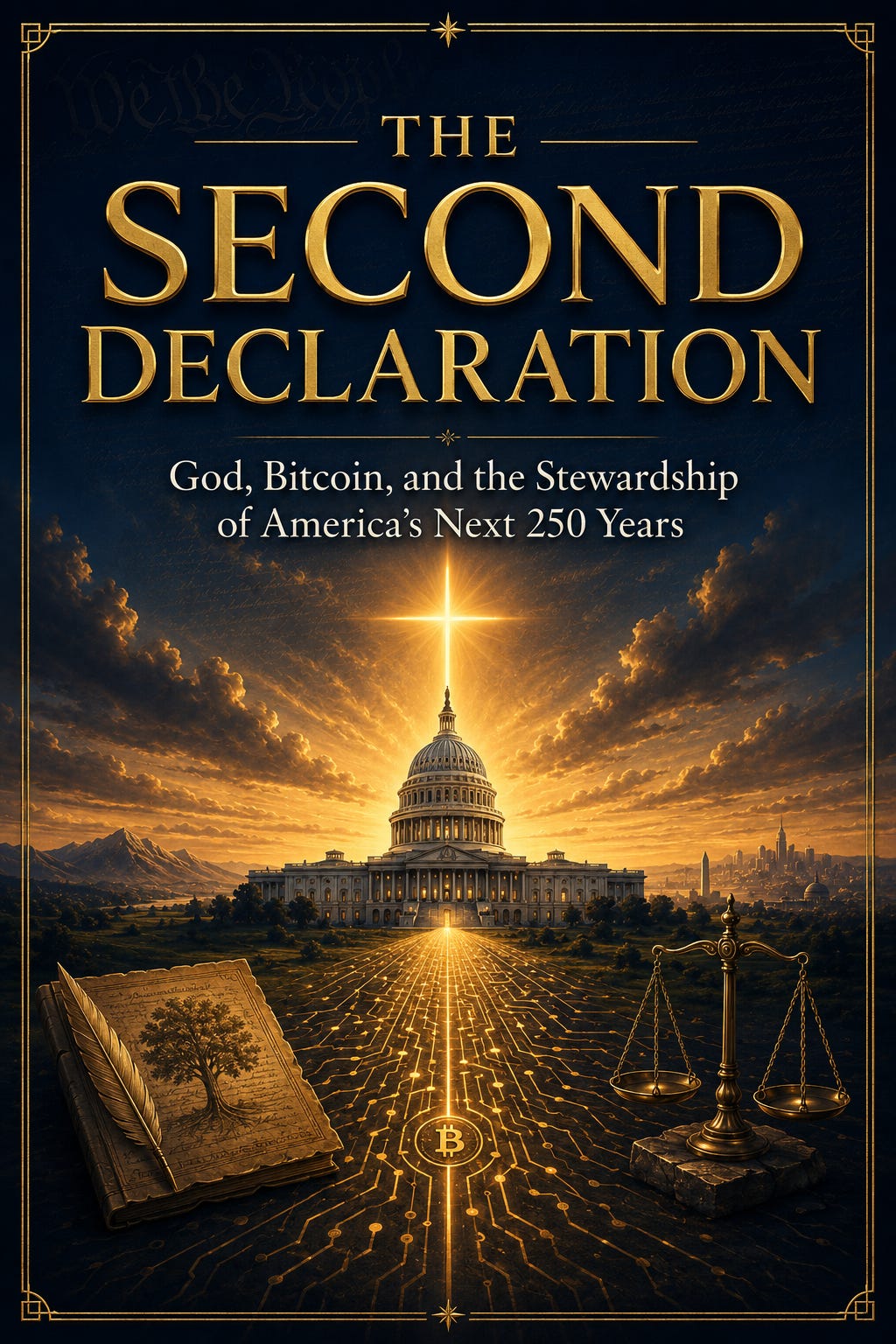
The Founders could not have imagined Bitcoin. They could not have conceived of a decentralized digital network secured by mathematics, maintained by participants around the world, and limited by rules no ruler can easily change. But they would have recognized the longing beneath it. They understood the desire for money that does not bend to political appetite. They understood that liberty weakens when the measure of value can be quietly altered. Bitcoin is not a new Declaration, and it is not salvation. Jesus is salvation. Bitcoin is, at most, a monetary echo of an older instinct: the conviction that some measures should stand beyond the reach of concentrated human power.
Perhaps that echo belongs in the time capsule, not at the center, but as a witness. Imagine someone placing Satoshi’s nine pages beside the parchments of freedom. A child asks what it is. The adult hesitates, then answers gently, “It was one generation’s attempt to make money honest again.” That may be enough. The future will judge whether we understood it well, stewarded it wisely, or treated it as another object of speculation while missing the moral question it raised.
Washington would understand the seriousness of that question. He had seen hunger at Valley Forge and knew that a nation’s promises are not abstract when men are freezing. Jefferson would recognize the danger of allowing earthly power to define what it did not create. Madison would ask where the checks and balances are when money itself is governed far from ordinary citizens. Lincoln would see the generational weight immediately. At Gettysburg, he spoke not only to the living, but to the unborn, pleading that government of the people, by the people, and for the people would not perish from the earth.
Micah gives us the posture required for such a moment. What does the Lord require of us? Not spectacle. Not sentiment. Not national self-congratulation. He calls us to act justly, love mercy, and walk humbly with our God. America at 250 requires that kind of humility. We should celebrate what God has allowed this nation to become, and we should ask where justice has been neglected, where mercy has been selective, and where pride has disguised itself as patriotism.
Isaiah deepens the challenge by reminding God’s people that true worship loosens chains and breaks yokes. That matters for money as much as it matters for law. Debt can become a yoke. Inflation can become a hidden chain. Dishonest measurement can quietly transfer burden from one generation to another while everyone insists the numbers still add up. A nation that loves liberty must care about every system that affects whether families can build, save, give, and leave something behind.
Hebrews describes the people of faith as a great cloud of witnesses surrounding us. That cloud is larger than our national story, but our national story has witnesses within it. The signers. The soldiers. The mothers who buried sons. The pastors who preached courage. The enslaved who heard the Declaration’s promise and demanded that America mean what it said. The abolitionists. The statesmen. The ordinary citizens who preserved freedom in small acts unseen by history. They do not ask us to worship them. They ask us to run our race.
By evening, the parades will be over. The speeches will fade. Smoke will drift through neighborhoods as fireworks disappear into darkness. Children will grow tired and fall asleep in folding chairs, back seats, or on the shoulders of fathers who carried them through the day. Somewhere a little girl will loosen her grip on a small flag as her father lifts her from the car and carries her toward the house. He will pause on the porch, careful not to wake her, and look back at the flag moving gently in the night air.
In that moment, history will become personal. The future will no longer be an idea discussed by politicians or historians. It will be asleep in his arms. The Founders once looked toward a world they would never see. So does every parent. So does every steward. So does everyone who chooses faithfulness over ease.
The fireworks will end. The question will remain.
What will we do with what we have been given?
Kingdom Principle 👑
Every generation must decide whether it will preserve or squander what it inherited.
God does not give freedom, truth, resources, or opportunity merely for our enjoyment. He entrusts them to us for faithful stewardship. The measure of our generation will not be what we received, but what we preserved, strengthened, and passed forward to those who come after us.
Prayer 🙏
Heavenly Father, thank You for the inheritance of freedom, faith, family, and truth. Thank You for the generations who sacrificed before us and for the opportunities You have placed in our hands today.
Teach us to act justly, love mercy, and walk humbly with You. Give us wisdom to steward this nation, our households, our resources, and our future with courage and humility. Help us remember that every blessing comes from You and every inheritance carries responsibility.
May we preserve what is true, repair what is broken, and pass forward something stronger than what we received. Let our lives honor You, bless our children, and point beyond every earthly nation to the eternal Kingdom of Jesus Christ.
In Jesus’ name, Amen. 🙏📖⚖️₿🕊️👑