

The Treaty of Paris had ended the war. It had not answered how freedom would govern itself. Yet, Robert Yates could not sleep.
Outside his window, New York was filled with the confident noise of a young nation imagining its future. Newspapers praised the proposed Constitution. Men in taverns argued over ratification with the urgency of people who knew the republic still stood on uncertain ground. Merchants spoke hopefully about stronger union, steadier trade, and the possibility that America might finally become something more durable than a collection of former colonies held together by memory and exhaustion. The Treaty of Paris had ended the war. It had not answered how freedom would govern itself.
Yates wanted to share their confidence. Instead, he found himself staring at the candle on his desk as the wax folded slowly into itself. A sheet of paper lay before him, still blank. He had spent months carrying a burden few other Americans possessed. Unlike those reading newspaper summaries or listening to public arguments, Yates had been inside the room. He had watched the Constitution being formed. He had listened as Madison reasoned with precision and Hamilton pressed for national strength. He had seen serious men wrestle with questions that would shape generations yet unborn.
He admired them. That was the problem.
Had the Constitution been written by fools, dismissing it would have been easy. Had it been drafted by tyrants, opposing it would have required little courage. But the men behind it were patriots. They had sacrificed for independence. They loved the republic. They wanted America to flourish. That made the danger harder to name, not easier. Yates feared that something dangerous was hiding inside something brilliant.
He read words the way a judge reads doors. He did not merely ask what the Constitution meant in the hands of honorable men today. He asked what future men might use it to become tomorrow. A clause was not only a phrase. A power was not only a promise. A structure was not only an intention. Yates had a legal mind, and legal minds understand that words create pathways. Once written, those pathways may be walked by men the writers never imagined.
The city slept. The candle burned lower. Yates finally reached for the pen.
History would remember Madison. It would remember Hamilton. It would barely remember him. Yet he wrote anyway, because the warning mattered more than his name.
He chose the name Brutus.
The choice was not accidental. It was a signal. In Roman memory, Brutus represented resistance to concentrated power, the willingness to stand against authority when authority threatened the republic. Yates was not trying to destroy America. He was trying to protect her before her people became too enamored with what they had built to ask what it might become. History remembers builders more easily than watchmen, but a house that ignores its watchmen may discover the danger too late.
In most American classrooms, Brutus appears briefly, if at all. The Federalist Papers receive the monument. The Anti-Federalists receive a footnote. Yet the protections Americans cherish most were shaped by the pressure of men who refused to trust power without written limits. The First Amendment, the Fourth, the protections of conscience, home, speech, process, and person did not drift gently into American life. They were forced into place by men who loved liberty enough to distrust even a government designed by patriots.
That is what makes Brutus so important.
He was not an enemy of the republic. He was one of its most concerned guardians.
The Bible tells a similar story in the life of Nathan. David was not merely Israel’s king. He was its hero, the giant slayer, the warrior, the poet, the man God had lifted from the fields and placed upon the throne. By the time Nathan approached him, David was surrounded by power, admiration, and the kind of silence that gathers around successful men. The higher a man rises, the fewer people remain willing to speak plainly to him.
Nathan knew what waited on the other side of the door. He knew what David had done. He knew what power could do to the person who dared to confront it. Prophets speak for God, but kings still hold swords. Nathan could have remained silent and told himself someone else would address the matter. He could have waited for a safer moment. He could have mistaken discretion for wisdom.
Instead, he walked in.
He did not begin with accusation. He began with a story: a rich man, a poor man, a stolen lamb. David listened and condemned the injustice before he realized the judgment had already turned toward him. Then Nathan delivered the sentence that changed the room.
“You are the man.”
Nathan’s courage was not rooted in a love of confrontation. It was rooted in a deeper loyalty. He loved God more than approval. He loved truth more than comfort. He loved David enough to risk David’s anger. The greatest acts of loyalty often look like opposition in the moment.
Brutus stood in that same tradition of faithful warning. He did not hate the Constitution. He feared what power might do once protected by its language. He did not despise Madison. He questioned whether Madison’s architecture could restrain the ambitions of men who would inherit it later. He did not oppose America. He refused to flatter her.
The disagreement between Madison and Yates is one of the great dramas of the Founding because both men wanted liberty to survive. Madison believed the constitutional frame would hold. Yates feared the frame might one day carry more weight than its builders imagined. Madison saw divided powers and institutional checks as a structure capable of restraining government. Yates looked at the same structure and worried that future leaders would discover how to stretch its beams.
This was not a contest between patriot and traitor. It was a debate between two patriots who understood the stakes differently. Madison was trying to build a government strong enough to overcome the weakness of the Articles of Confederation. Yates was trying to make sure that strength did not become consolidation. Hamilton feared a government too weak to govern. Brutus feared one that might one day become too strong to restrain. They were not debating abstractions. They were debating what kind of inheritance future Americans would receive.
That is why the argument still matters.
The tendency Brutus feared did not disappear with ratification. It settled into the long life of the republic, appearing whenever authority found reasons to make temporary powers permanent, whenever distant institutions claimed necessity, whenever the people were asked to trade limits for efficiency. This chapter should not steal the full theological anthropology that belongs later to Madison and Genesis, but it must say this much: Brutus understood that power needs boundaries because men do not become angels when they enter office.
His warning helped produce one of the greatest inheritances in American history.
The Bill of Rights did not appear because Americans trusted government. It appeared because enough Americans understood that trust without boundaries is not liberty. The First Amendment protected the conscience and the voice. The Fourth drew a line around the home. Due process restrained the machinery of accusation. The right to bear arms acknowledged that a free people could not be treated merely as subjects to be managed, but as citizens bearing responsibility. These protections were not ceremonial additions. They were locks placed on doors before future power tried the handle.
The parchment of warning became the parchment of protection.
That sentence matters because it reveals how inheritance often works. One generation hears a warning, wrestles with it, resists it, and eventually receives it as wisdom. The Bill of Rights is what happens when warning becomes inheritance.
Yates never saw our homes. Madison never held our children. Hamilton never imagined the details of our age. Yet their argument still shapes the rooms where we pray, speak, write, gather, teach, dissent, defend, and raise families. The freedoms Americans often assume were purchased not only by soldiers in the field but by men willing to be misunderstood in debate.
The men who debated ratification never knew our names, yet they argued for us anyway.
That is stewardship.
It is easy to read history as though names on paper were less human than we are. We compress years into paragraphs and forget the sleepless nights, the friendships strained, the reputations risked, and the uncertainty carried by men who could not know whether their judgments would prove wise. Yates worried about a future he would never see. Madison defended a Constitution whose success he could not guarantee. Both men were arguing not merely for their own generation, but for descendants who would inherit the consequences.
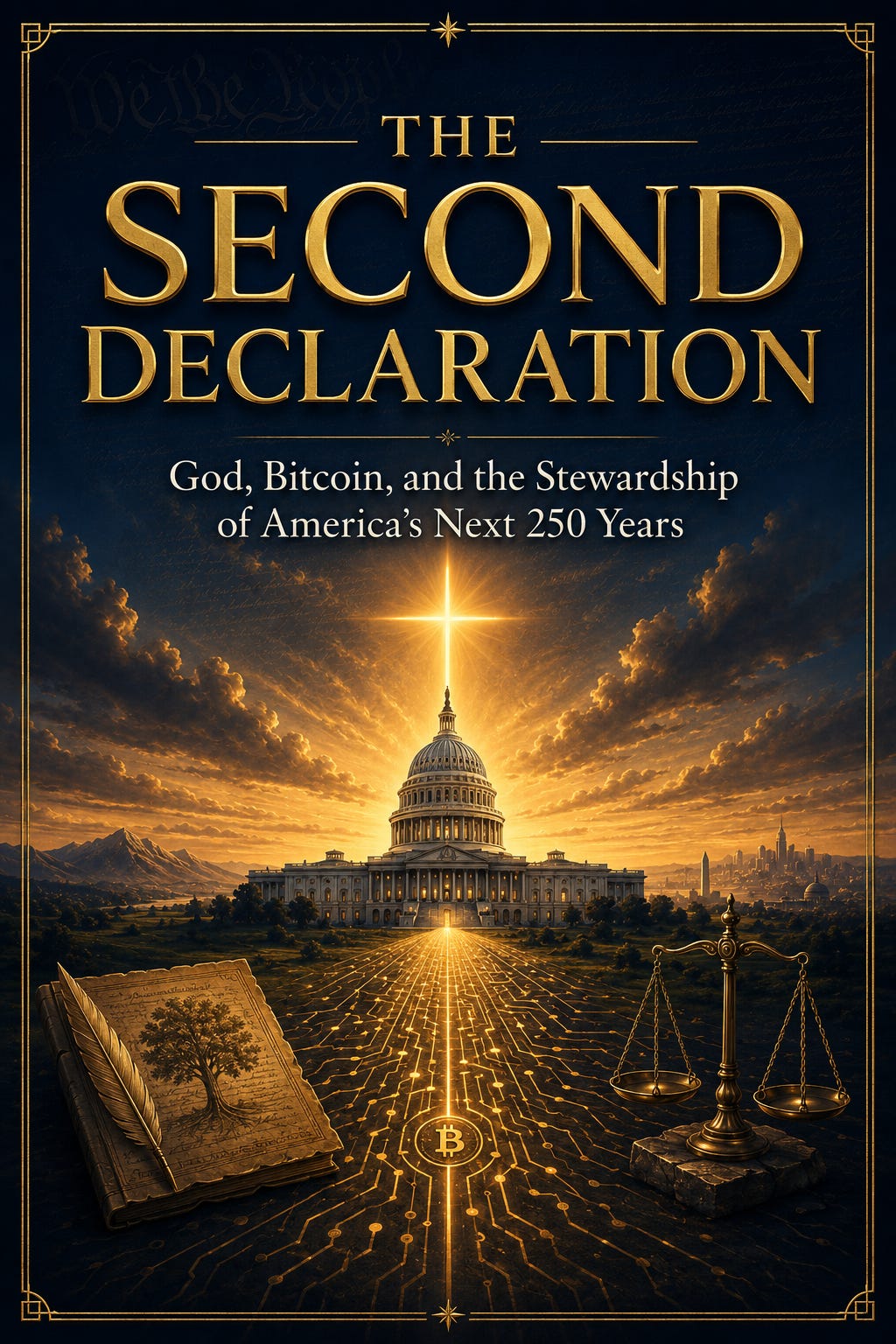
Every generation inherits a parchment, a scale, and a choice. In this chapter, the parchment is not explained so much as witnessed. Brutus wrote on paper, but the warning did not remain paper. It became argument, then pressure, then amendment, then protection. The scale appears only as a seed here, measuring whether power remains servant or becomes master. The choice belongs to every generation that receives liberty already guarded by the courage of those who came before.
That inheritance should humble us.
More than two centuries after Brutus wrote his warnings, another anonymous figure found himself staring at a different concentration of power. The year was 2008. Financial institutions once considered untouchable were collapsing. Governments intervened. Central banks expanded their influence. Trust, the invisible foundation beneath modern finance, appeared increasingly fragile.
An unknown writer using the name Satoshi Nakamoto published nine pages into that crisis. He was not warning about legislative clauses or federal authority. He was warning, in the language of code, that monetary power had gathered at the center and could no longer be treated as harmless. The comparison is not exact. It does not need to be. Some warnings rhyme across centuries because human nature does.
Brutus looked at concentrated political power and refused to call it inevitable. Satoshi looked at concentrated monetary power and did the same. One wrote essays. The other wrote software. One helped force protections around political liberty. The other introduced architecture for money without a central issuer. Both understood that future generations might need something better than appeals to restraint from those who hold power.
History remembers Madison, and rightly so. It should remember Brutus as well. Not because he won every argument. Not because he saw everything clearly. But because he was willing to stand alone before the danger was obvious to everyone else.
Sometimes the most faithful voice in history is the one standing apart from the crowd.
Brutus warned a young republic about power before the nation had even learned to live inside the house it had built. Two hundred and fifty years later, the warning still waits for us. If concentrated political power required restraint, what should a free people do when monetary power gathers in the same way?
Kingdom Principle 👑
Love tells the truth before power becomes untouchable.
Nathan confronted David because he loved truth more than comfort. Brutus challenged the Constitution because he loved liberty more than approval. Faithful stewardship often requires speaking difficult truths before problems become permanent.
Prayer 🙏
Heavenly Father, thank You for the men and women throughout history who chose faithfulness over popularity and truth over comfort. Give us courage to speak honestly, listen humbly, and pursue wisdom when the crowd prefers applause over warning.
Protect us from trusting human power more than Your authority. Teach us to steward faithfully the freedoms we have inherited and to build foundations of truth for generations we may never meet. May we love truth enough to defend it and love others enough to speak it.
In Jesus’ name, Amen. 🙏📖⚖️🕊️👑